.png)
Data teams need a catalog when trust in their data starts to break down. Analysts struggle to find reliable datasets. Governance teams cannot confirm ownership or track access. AI projects use sources that have not been approved.
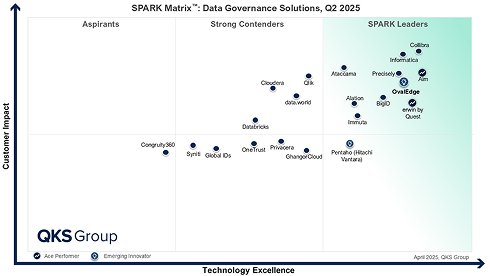
The right data catalog tool choice depends on your operating model. Enterprise suites such as Collibra, Informatica IDMC, and Alation suit regulated programs with formal stewardship. Microsoft Purview and Snowflake Horizon work well for cloud-focused data environments. OvalEdge and Atlan offer multi-cloud governance with a shorter implementation timeline.
We scored each tool on Crawl, Curate, and Consume, helping you identify the two or three options that best match your data stack, governance needs, and rollout capacity.
What is a data catalog platform?
A data catalog platform is software that gives teams one governed place to find and trust the data they need. It pulls metadata from your source systems automatically and keeps that inventory current.
Lineage tracking shows where each dataset came from and how it's used. Sensitive data gets classified against the business glossary, and access policies are enforced from the same layer.
Quick reference: Top 15 data catalog platforms at a glance
The best data catalog tools in 2026 fall into three categories. Enterprise governance suites fit regulated programs with formal stewardship. Cloud-native catalogs fit teams inside a single cloud. Modern independents fit multi-cloud teams that need vendor-neutral governance without a nine-month rollout.
Use the table below to shortlist two or three platforms before reading the full profiles. Pricing tiers reflect typical published or industry-observed ranges as of September 2026 and should be confirmed with each vendor.
|
Platform |
Segment |
Stands out for |
Governance depth |
Deployment speed |
Pricing model |
|
OvalEdge |
Modern independent |
Unified governance with lineage, quality, and AI-ready context |
Very strong |
4–8 weeks |
Custom quote; mid-market pricing |
|
Atlan |
Modern independent |
Active metadata and modern data stack integrations |
Strong |
4–8 weeks |
Custom quote; mid-to-enterprise pricing |
|
Secoda |
Modern independent |
Fast deployment and AI-assisted search |
Moderate |
1–2 weeks |
Tiered plans; custom enterprise pricing |
|
data.world |
Modern independent |
Knowledge graph-based relationship discovery |
Strong |
4–6 weeks |
Custom quote; mid-market pricing |
|
Select Star |
Modern independent |
Column-level lineage without enterprise overhead |
Moderate |
2–4 weeks |
Tiered plans; free plan available |
|
Coalesce Catalog |
Modern independent |
AI-generated documentation with less manual curation |
Moderate |
2–4 weeks |
Tiered plans; from $150 monthly |
|
BigID |
Modern independent |
Privacy-focused discovery and risk scoring |
Strong, privacy-focused |
4–8 weeks |
Custom quote; usage-based pricing |
|
Collibra |
Enterprise governance |
Stewardship workflows and compliance reporting |
Very strong |
3–9 months |
Custom quote; enterprise pricing |
|
Informatica IDMC |
Enterprise governance |
AI classification and hybrid-environment lineage |
Strong |
3–9 months |
Consumption-based; custom quote |
|
Alation |
Enterprise governance |
Behavioral intelligence and broad analyst recognition |
Strong |
2–6 months |
Custom quote; enterprise pricing |
|
IBM Watson Knowledge Catalog |
Enterprise governance |
Governance for data and AI within IBM Cloud |
Strong |
3–6 months |
Custom quote; Cloud Pak bundle |
|
Microsoft Purview |
Cloud-native platform |
Native Azure and Microsoft 365 governance |
Strong |
2–4 weeks, Azure-native |
Pay-as-you-go; per governed asset |
|
AWS Glue Data Catalog |
Cloud-native platform |
Serverless metadata storage for AWS workloads |
Basic |
Days, AWS-native |
Pay-as-you-go; first 1M objects free |
|
Snowflake Horizon |
Cloud-native platform |
Governance built into the Snowflake platform |
Strong |
2–4 weeks, Snowflake-native |
Included with Snowflake; usage charges apply |
|
Databricks Unity Catalog |
Cloud-native platform |
Lakehouse governance for data and AI assets |
Strong |
2–4 weeks, Databricks-native |
Included with Databricks; usage charges apply |
Our platform, OvalEdge, sits at the top of the table. We have scored it on the same Crawl, Curate, and Consume framework, and vendor rows are grouped by segment so the comparison stays honest.
7 features to look for in data catalog tools
The most important data catalog features are the ones that help teams discover complete metadata, apply governance controls, and find trusted data quickly. Evaluate how well each platform performs these functions during demos and trials instead of comparing feature counts.
1. Connector coverage beyond table names
Schema-only connectors provide limited context. Prioritize connectors that also capture:
-
Column metadata.
-
Query history.
-
Access logs.
Connector depth matters more than the number of integrations.
2. Column-level lineage
Table-level lineage shows connected datasets. Column-level lineage identifies the upstream field affecting a metric or dashboard. Ask vendors to trace one field from its source to a downstream report during the demo.
3. A glossary connected to data assets
Glossary terms should link directly to datasets and columns. Changes to linked assets should alert stewards, while approved definitions should appear in search results. Otherwise, the glossary risks becoming another outdated wiki.
4. Sensitive data classification and enforcement
The catalog should detect sensitive data, label it, and apply the correct access policy within one workflow. Requiring separate tools for classification and enforcement makes governance harder to maintain.
5. Search that prioritizes trusted data
Analysts should be able to find reliable datasets without inspecting several metadata pages. Look for:
-
Usage-based rankings.
-
Verified asset labels.
-
Visible data owners.
-
Sensitivity filters.
If search is slow or unclear, users will return to asking coworkers in Slack.
6. Governed context for AI tools
AI agents and copilots need access to approved definitions, lineage, and data classifications. The catalog should provide that context through an API while preserving existing access controls.
7. A practical deployment timeline
Implementation speed can narrow your shortlist quickly. Enterprise suites may take three to nine months. Cloud-native platforms can take days or weeks, while modern independent catalogs often take two to eight weeks.
Request a timeline covering setup, metadata ingestion, policy configuration, and user onboarding. Include the ingestion architecture in the deployment plan. Isolating catalog ingestion from production orchestration through a separate service or dedicated worker queue prevents metadata scans and lineage jobs from competing with business pipelines.
For a structured comparison based on weighted criteria and stakeholder priorities, use the Isolating catalog ingestion from production orchestration.
7 modern independent data catalog tools
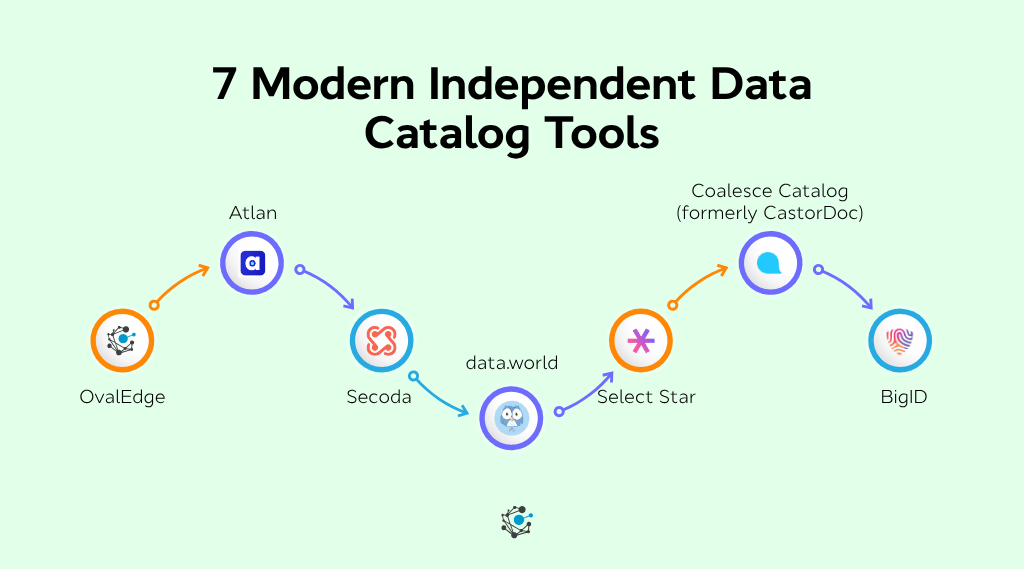
Modern independent catalogs are vendor-neutral platforms built for agility, business-user adoption, and faster time-to-value. They are not locked to a single cloud ecosystem, which makes them a natural fit for organizations running data across multiple clouds, on-prem systems, and SaaS tools.
Governance depth varies across this segment, so the right pick depends on whether you need a full governance platform or a lighter discovery and documentation layer.
1. OvalEdge
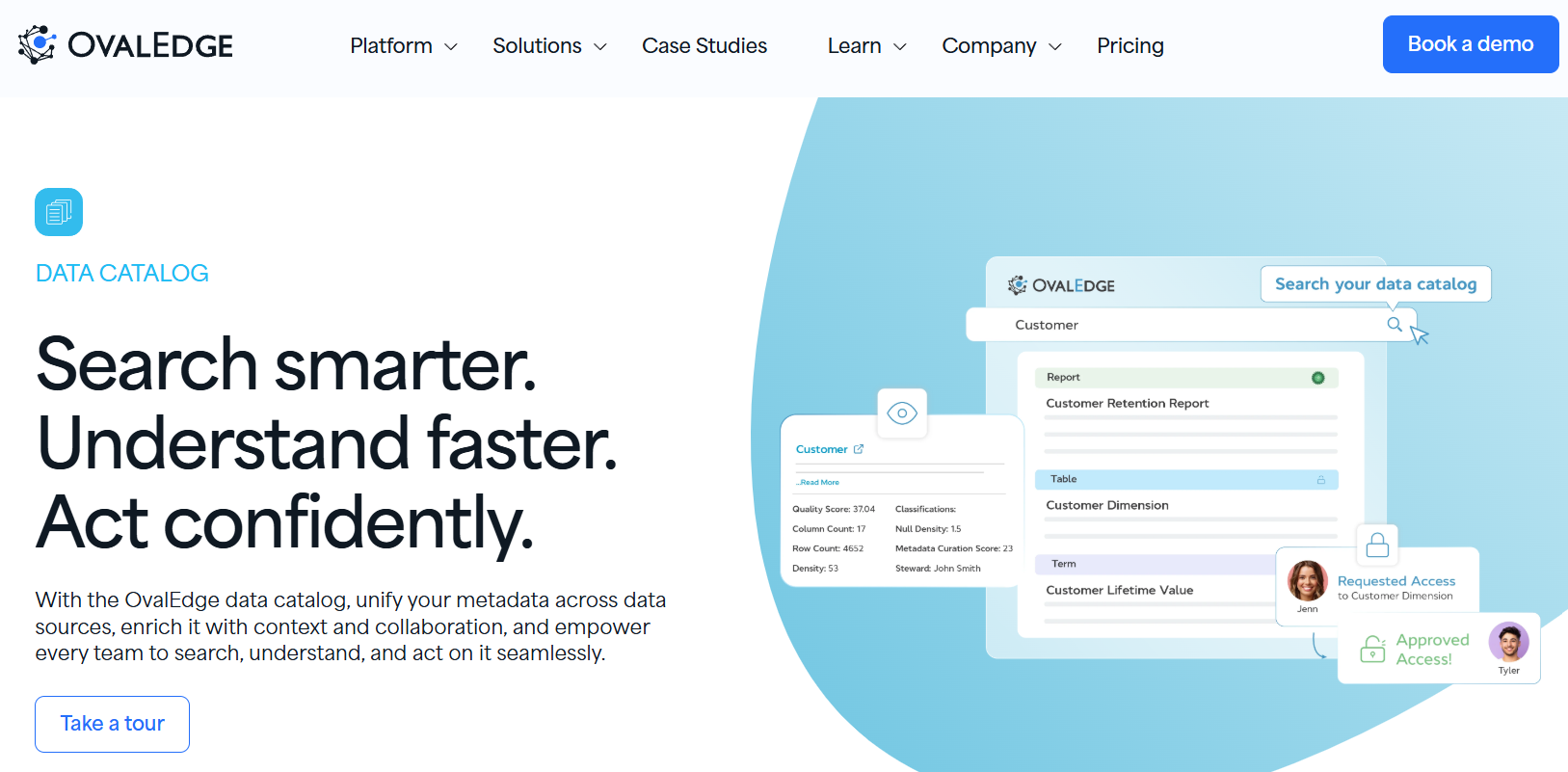
OvalEdge is a unified data catalog and governance platform that pairs broad connectivity with stewardship workflows, data quality, and agentic analytics in a single system. It is built for teams that want governed data operations without stitching separate tools together.
G2 rating: 5/5
Crawl / Curate / Consume: 9/10 / 9/10 / 8/10 (Total: 26/30)
What does OvalEdge actually do that other data catalogs don't?
OvalEdge's difference lies in how it connects catalog, governance, and AI-ready context inside one governed environment.
-
Enterprise Context Graph: Connects ontology, glossary, lineage, quality, ownership, and policy so humans and AI systems operate from governed enterprise context.
-
Source Code Intelligence: Parses SQL, ETL jobs, BI reports, stored procedures, and application code to extract lineage, transformation logic, and metric definitions directly from production systems.
-
OvalEdge Agents: Purpose-built agents support catalog curation, glossary creation, sensitive data classification, quality rule recommendations, ownership, and governed data product creation.
-
170+ native connectors: Capture active and extended metadata across databases, SaaS applications, BI platforms, ETL systems, legacy infrastructure, and files.
-
Governed AI consumption: askEdgi, context APIs, and an MCP server make governed business context available to analytical and AI workflows.
A 2026 Forrester TEI study of a composite OvalEdge customer found 337% ROI with payback in under six months, a 75% reduction in compliance team effort for sensitive data discovery, and PII and PCI detection across an enterprise in 45 days from proof-of-concept start.
Crawl-Curate-Consume Fit:
-
Crawl: Very strong. Broad connectivity is combined with Source Code Intelligence for deeper lineage and business-logic extraction.
-
Curate: Very strong. The Enterprise Context Graph connects glossary, lineage, quality, policies, and ownership while agents automate repetitive governance activities.
-
Consume: Strong. Natural-language analytics, browser integrations, context APIs, and MCP access extend governed information into business and AI workflows.
Best for: Mid-to-large enterprises that need catalog, governance, lineage, quality, and AI-ready context across multi-cloud, hybrid, or regulated data environments.
Hallmark case study: Hallmark uses OvalEdge to run Right to Know and Right to Delete requests through a single catalog, combining PII classification, business glossary, and governed queries into one privacy workflow.
The result: consistent visibility into where consumer PII lives, routed requests with ownership and audit trails, and a foundation that now extends into data quality and AI-ready analytics.
Read the Hallmark case study →
Limitations: OvalEdge has less name recognition than long-established vendors such as Collibra and Alation. Teams seeking only lightweight metadata search may not require its broader governance capabilities.
Explore how OvalEdge connects catalog, governance, and AI-ready enterprise context. Book a data catalog demo to see how it fits your stack.
2. Atlan
G2 rating: 4.5/5
Crawl / Curate / Consume: 8/10 / 8/10 / 9/10 (Total: 25/30)
4.5/5 is a modern data catalog positioned as an active metadata platform and the enterprise context layer for AI. Named a Leader in Gartner's 2025 Metadata Management Magic Quadrant and Forrester's 2024 Enterprise Data Catalogs Wave, it is the most commonly shortlisted catalog for cloud-native data stacks.
What does Atlan actually do that other data catalogs don't?
Atlan's difference sits in five design choices that show up the day you start using it.
-
Active metadata: Continuously updated metadata that flows across the stack rather than sitting in a static inventory.
-
Modern stack integrations: Deep, native connectors for Snowflake, dbt, Databricks, Sigma, and Looker.
-
Automated documentation: AI-generated descriptions, READMEs, and column-level documentation that reduce manual curation.
-
Embedded collaboration: Slack, Jira, and Google Workspace integrations that bring governance into existing workflows.
-
Persona-based experiences: Separate views for data engineers, analysts, and business users within the same platform.
Crawl-Curate-Consume Fit:
-
Crawl: Strong. Deep integrations provide good coverage across modern cloud data stacks.
-
Curate: Strong. AI documentation and metadata automation reduce manual governance work.
-
Consume: Very strong. Persona-based experiences and workflow integrations support rapid adoption.
Best for: Modern data stack teams that want an active metadata platform with fast adoption and strong analyst recognition.
Limitations: Enterprise TCO climbs as you add seats, connectors, and governance modules. Governance depth for highly regulated industries may require additional tooling.
3. Secoda
G2 rating: 4.5/5
Crawl / Curate / Consume: 6/10 / 6/10 / 8/10 (Total: 20/30)
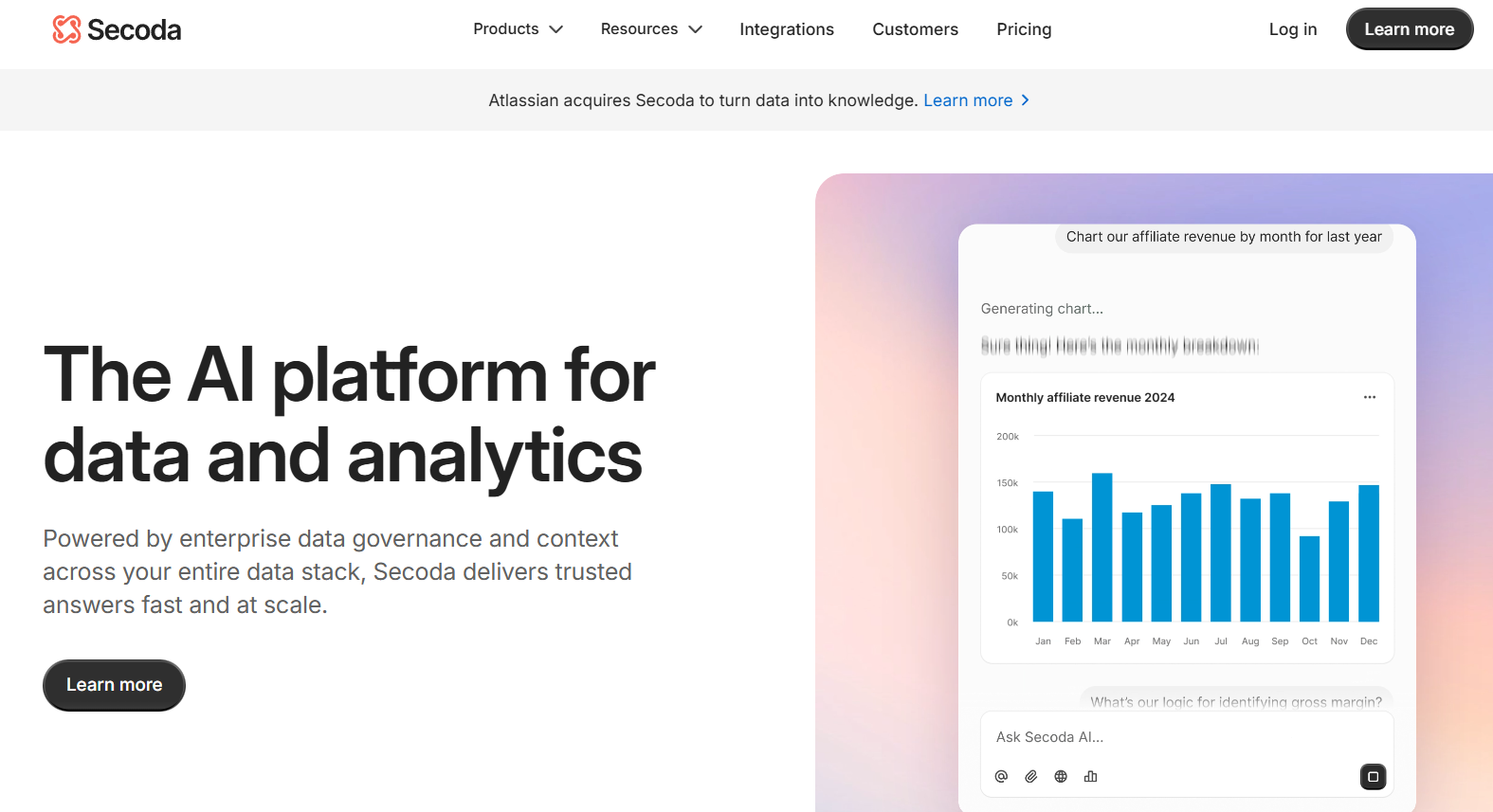
Secoda is a lightweight data catalog focused on speed. It is designed for lean teams that want search, documentation, and basic governance without a heavy implementation cycle. Most teams reach production in one to two weeks.
What does Secoda actually do that other data catalogs don't?
Secoda's difference is speed. It strips the catalog down to the four capabilities most teams actually use, and skips the enterprise weight that slows adoption.
-
AI-powered search: Natural language queries that surface datasets, definitions, and documentation across connected sources.
-
Automated documentation: AI-generated descriptions and metadata enrichment that reduce manual effort.
-
Fast deployment: One-to-two-week implementation timeline, the fastest in this guide.
-
Governance essentials: Ownership tracking, tagging, and access request workflows for teams starting their governance journey.
Crawl-Curate-Consume Fit:
-
Crawl: Moderate. Modern stack connectivity and a short implementation cycle support rapid adoption.
-
Curate: Moderate. Core ownership and governance functions are present without enterprise-level stewardship depth.
-
Consume: Strong. Natural-language search and a simple interface make discovery accessible to non-technical users.
Best for: Fast-growing data teams on modern stacks that need a catalog deployed in days, not months.
Limitations: Governance depth is lighter than enterprise-grade platforms. Teams with complex compliance requirements may outgrow it.
4. data.world
G2 rating: 4.2/5
Crawl / Curate / Consume: 7/10 / 8/10 / 7/10 (Total: 22/30)
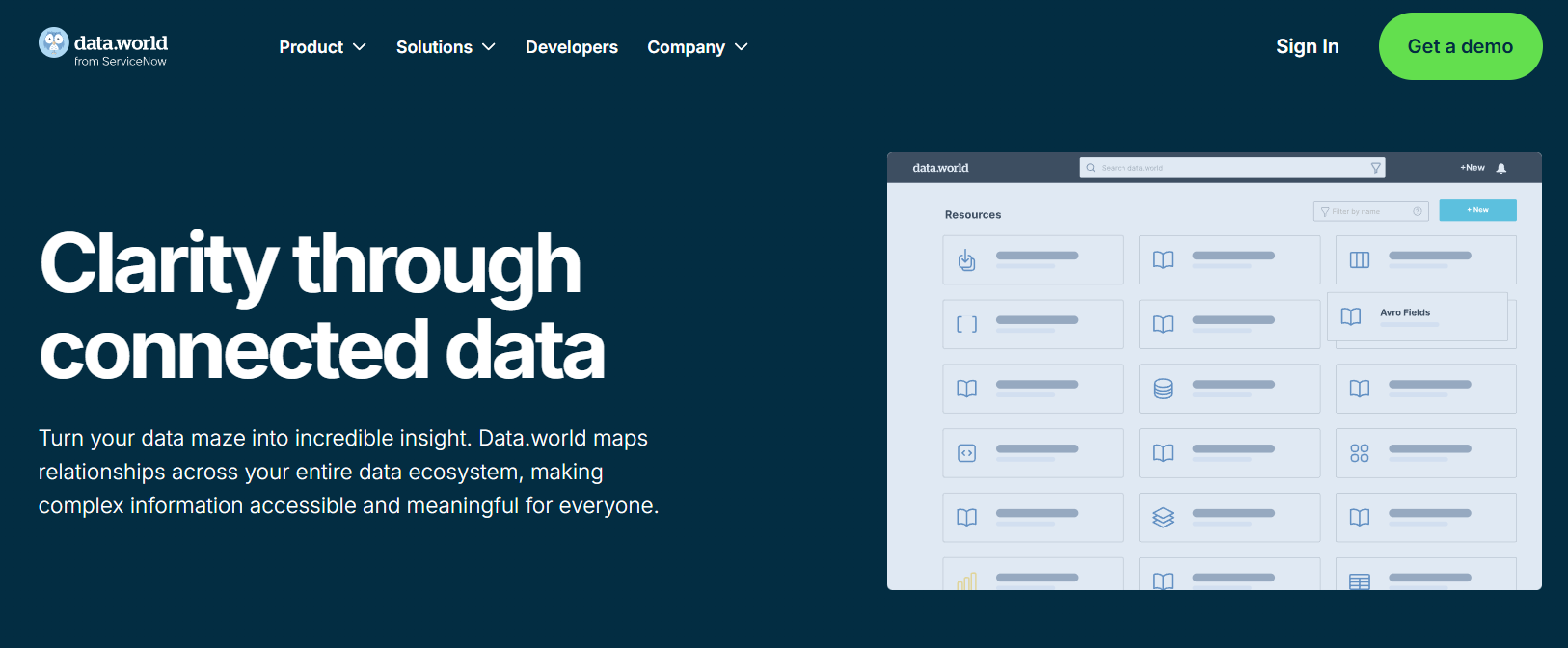
data.world is a data catalog and governance platform built on a unique knowledge-graph foundation. Recently acquired by ServiceNow, it connects datasets, definitions, and business context in a graph structure that makes relationships between assets visible and queryable.
What does data.world actually do that other data catalogs don't?
Its difference is the knowledge graph. Most catalogs store metadata in flat tables and add relationships later. data.world builds those relationships into the structure from day one.
-
Knowledge graph engine: Graph-based metadata model that surfaces relationships between datasets, reports, and business terms.
-
Collaborative governance: Built-in discussions, project workspaces, and social features that encourage cross-team curation.
-
Federated queries: Query across connected sources without moving data into a central warehouse.
-
ServiceNow integration: Growing coupling with ServiceNow's workflow and ITSM platform post-acquisition.
Crawl-Curate-Consume Fit:
-
Crawl: Strong. Federated capabilities provide visibility across distributed data.
-
Curate: Strong. Graph relationships make connections among technical and business assets explicit.
-
Consume: Strong. Collaboration features encourage cross-functional participation in governance.
Best for: Organizations that want a graph-based approach to governance and collaboration, especially those already in the ServiceNow ecosystem.
Limitations: Post-acquisition roadmap clarity may vary. Less commonly shortlisted for heavily regulated governance programs compared to Collibra or Informatica.
5. Select Star
G2 rating: 4.5/5
Crawl / Curate / Consume: 7/10 / 6/10 / 7/10 (Total: 20/30)
Select Star is a modern catalog built around automated, column-level lineage. It focuses on giving analysts and engineers fast visibility into where data comes from, how it transforms, and who depends on it, without a heavy governance layer on top.
What does Select Star actually do that other data catalogs don't?
Its difference is lineage depth. Most catalogs promise lineage; Select Star was built lineage-first and the rest of the catalog sits on top of it.
-
Column-level lineage: Granular tracking of data origins and transformations at the field level, not just the table level.
-
Automated discovery: Continuous scanning that maps your data estate without manual ingestion setup.
-
Popularity signals: Usage analytics that surface the most-queried and most-trusted datasets across the organization.
-
Lightweight deployment: Fast onboarding with minimal configuration for small-to-mid teams.
Crawl-Curate-Consume Fit:
-
Crawl: Strong. Automated scanning and lightweight onboarding support rapid inventory creation.
-
Curate: Moderate. Lineage is a major strength, but policy, glossary, and stewardship capabilities are lighter.
-
Consume: Strong. Usage signals help analysts identify commonly used and trusted assets.
Best for: Small-to-mid teams that need detailed lineage and discovery without the overhead of a full governance suite.
Limitations: Not a full governance platform. Teams needing stewardship workflows, policy enforcement, or glossary management will need to pair it with other tooling.
6. Coalesce Catalog (formerly CastorDoc)
G2 rating: 4.7/5
Crawl / Curate / Consume: 6/10 / 6/10 / 7/10 (Total: 19/30)
Coalesce Catalog (formerly CastorDoc) is an AI-first data catalog that automates documentation, classification, and discovery. It is designed for teams that want governed, well-documented data assets without spending months on manual curation.
What does CastorDoc actually do that other data catalogs don't?
Its difference is how far the AI takes documentation. Most catalogs promise AI-assisted writing; CastorDoc treats it as the default path and manual curation as the exception.
-
AI-generated descriptions: Automatic documentation for tables, columns, and datasets using LLM-powered summarization.
-
Self-service discovery: Natural language search that lets business users find and understand data without technical training.
-
Governance workflows: Ownership assignment, tagging, and access request management.
-
Stack integrations: Connectors for modern warehouses, BI tools, and transformation layers.
Crawl-Curate-Consume Fit:
-
Crawl: Moderate. Connectivity focuses primarily on modern warehouses, BI tools, and transformation platforms.
-
Curate: Moderate. Automated documentation reduces manual effort, while governance remains comparatively lightweight.
-
Consume: Strong. AI-assisted documentation and search support business-user self-service.
Best for: Teams that want AI-assisted documentation and self-service governance with minimal manual setup.
Limitations: Works best within modern data stacks it is ready to integrate with. Less mature for legacy or hybrid environments.
7. BigID
G2 rating: 4.3/5
Crawl / Curate / Consume: 7/10 / 8/10 / 6/10 (Total: 21/30)
BigID approaches cataloging from the privacy and security side. It is centered around sensitive data discovery, identity-aware governance, and risk scoring, making it the go-to catalog for organizations where data protection comes before data discovery.
Key features:
-
Sensitive data discovery: ML-driven classification that finds PII, PHI, financial data, and custom sensitive categories at scale.
-
Identity-aware governance: Links data assets to the individuals they describe, enabling privacy-centric access controls.
-
Risk scoring: Automated risk assessment and policy enforcement based on data sensitivity and exposure.
-
Compliance automation: Pre-built modules for GDPR, CCPA, HIPAA, and other regulatory frameworks.
Crawl-Curate-Consume Fit:
-
Crawl: Strong. Sensitive data scanning spans structured and unstructured sources.
-
Curate: Very strong for privacy. Risk scoring, identity context, and compliance controls are central strengths.
-
Consume: Moderate. Privacy and security take priority over broad analytics discovery and business self-service.
Best for: Enterprises where data privacy, security, and regulatory compliance are the primary drivers for adopting a catalog.
Limitations: Privacy-first positioning means lighter coverage on traditional catalog features like business glossary, stewardship workflows, and self-service analytics. Can be expensive at scale.
Top 4 Enterprise Data Catalog and Governance Suites
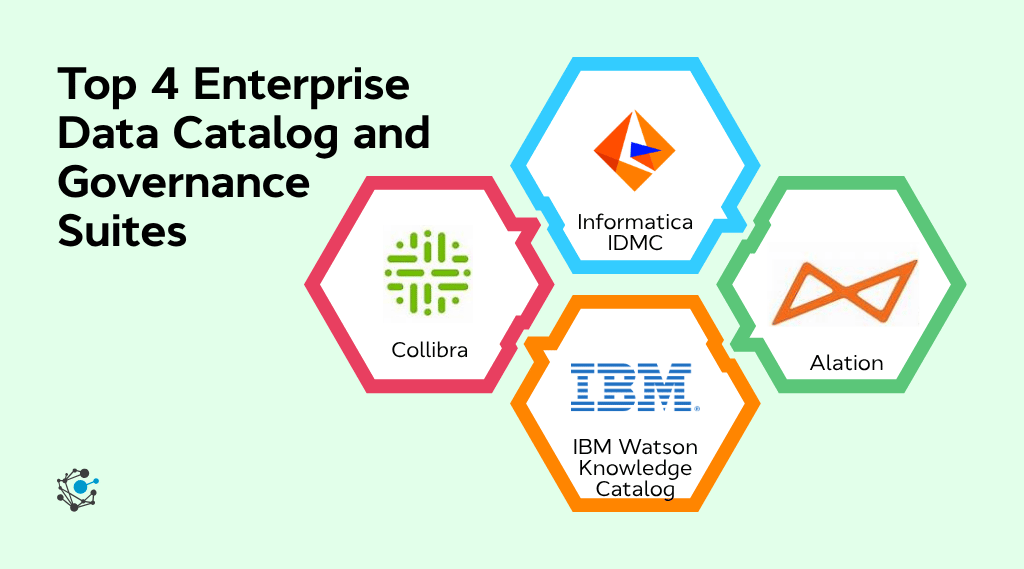
Enterprise governance suites are built for organizations that need formal stewardship, broad connectivity, auditability, and regulatory controls. Their governance depth comes with higher costs and longer implementation cycles, making them best suited to complex or regulated environments.
8. Collibra
G2 rating: 4.2/5
Crawl / Curate / Consume: 8/10 / 9/10 / 6/10 (Total: 23/30)
Collibra is a long-standing enterprise governance and catalog platform designed for regulated, multi-cloud environments where formal stewardship and compliance reporting are major requirements.
What does Collibra actually do that other data catalogs don't?
Its difference is enterprise governance depth. Where most catalogs treat stewardship as a module, Collibra was built around it, and the rest of the platform sits on that foundation.
-
Stewardship workflows: End-to-end policy management, role assignment, and compliance reporting at enterprise scale.
-
Business glossary: Collaborative curation that aligns definitions across business and technical teams.
-
Unlimited viewer licenses: Free read access so the entire organization can search and consume governed assets.
-
Data quality and AI governance: Available as add-on modules for teams that need quality scoring and AI oversight.
Crawl-Curate-Consume Fit:
-
Crawl: Strong. Broad connectors and automated metadata collection cover cloud and on-prem environments.
-
Curate: Very strong. Mature stewardship, policy automation, governance roles, and regulatory audit trails are core strengths.
-
Consume: Moderate. Unlimited viewer licenses support broad access, although platform complexity can create a learning curve.
Best for: Compliance-heavy enterprises that need formal governance depth and can resource the implementation.
Limitations: Premium pricing with significant add-on modules, and a learning curve that matches the platform's depth.
Choose Collibra if regulatory governance depth is the priority and budget supports it. See our Collibra alternatives guide for a deeper comparison.
9. Informatica IDMC
G2 rating: 4.3/5
Crawl / Curate / Consume: 9/10 / 8/10 / 6/10 (Total: 23/30)
Informatica's catalog, part of its Intelligent Data Management Cloud, is an enterprise-grade, AI-driven platform known for deep metadata management and lineage. Its CLAIRE AI engine powers classification, discovery, and automation across hybrid environments.
What does Informatica IDMC actually do that other data catalogs don't?
Its difference is coverage and automation across hybrid estates. Where most catalogs optimize for cloud or on-prem, Informatica was built to govern both from the same platform, with CLAIRE doing much of the heavy lifting.
-
CLAIRE AI engine: ML-based classification and discovery across cloud, on-prem, and big data sources.
-
Advanced lineage: End-to-end lineage and impact analysis at enterprise scale.
-
Unified ecosystem: Governance, data quality, privacy, and integration modules in one platform.
-
Hybrid coverage: Broad connectors spanning legacy systems, cloud warehouses, and SaaS tools.
Crawl-Curate-Consume Fit:
-
Crawl: Very strong. Extensive connectivity makes Informatica particularly suitable for large hybrid estates.
-
Curate: Strong. Classification, privacy, quality, and governance capabilities operate across the broader Informatica ecosystem.
-
Consume: Moderate. Its breadth provides substantial capability but can introduce complexity for teams primarily seeking discovery.
Best for: Large enterprises with complex hybrid estates that want deep automation and can invest in the Informatica ecosystem.
Limitations: Powerful but complex, with real implementation effort and a pricing model that climbs quickly at scale.
Choose Informatica if you are standardizing a large hybrid environment on one governance ecosystem. See our Informatica alternatives guide for a deeper comparison.
10. Alation

G2 rating: 4.4/5
Crawl / Curate / Consume: 8/10 / 8/10 / 9/10 (Total: 25/30)
Alation is one of the original data catalog vendors, founded in 2012 and now positioned as a data intelligence platform with agentic AI capabilities. Named a Leader in both Gartner's 2025 Magic Quadrant and Forrester's Q1 2025 Wave, it is a common shortlist name for enterprise buyers.
What does Alation actually do that other data catalogs don't?
Its difference is behavioral intelligence. Where most catalogs describe what data exists, Alation watches how people actually use it and turns that signal into governance and discovery lift.
-
Behavioral analysis engine: ML-driven recommendations based on how people actually use data across the organization.
-
Active metadata: Combines behavioral signals, lineage, and governance context to surface risk and automate stewardship.
-
Collaborative stewardship: Built-in workflows for documentation, curation, and cross-team data trust.
-
Agentic capabilities: AI agents that automate governance tasks like documentation, quality control, and data packaging.
-
Broad ecosystem: Native integrations with modern stack tools like Snowflake, dbt, Databricks, and major BI platforms.
Crawl-Curate-Consume Fit:
-
Crawl: Strong. Integrations across platforms such as Snowflake, dbt, Databricks, and major BI tools support modern enterprise environments.
-
Curate: Strong. Collaborative stewardship and active metadata help automate documentation and governance activities.
-
Consume: Very strong. Behavioral intelligence and a polished user experience support business-user discovery and adoption.
Best for: Mid-to-large enterprises that want a mature, widely adopted catalog with a polished business-user experience and strong analyst validation.
Limitations: Total cost of ownership climbs as you add licenses, connectors, and governance modules. Can be heavy for smaller teams.
11. IBM Watson Knowledge Catalog
G2 Rating: Undisclosed
Crawl / Curate / Consume: 6/10 / 8/10 / 6/10 (Total: 20/30)
IBM's Watson Knowledge Catalog supports cloud-native governance and AI readiness, tightly integrated with the IBM Cloud Pak for Data ecosystem. It pairs cataloging with embedded data quality scoring and profiling for organizations already invested in IBM's stack.
What does IBM Watson Knowledge Catalog actually do that other data catalogs don't?
Its difference is that catalog, data quality, and AI model governance sit on the same platform, purpose-built for organizations already running on IBM's stack.
-
Embedded quality scoring: Data profiling and quality metrics built into the catalog experience.
-
AI model governance: Tools for tracking and governing AI models alongside traditional data assets.
-
Cloud Pak integration: Deep coupling with IBM's broader data fabric, AI, and analytics platform.
-
Policy automation: Automated enforcement of data access and usage policies across the IBM environment.
Crawl-Curate-Consume Fit:
-
Crawl: Moderate. Strong IBM integration, with comparatively narrower coverage outside the ecosystem.
-
Curate: Strong. Data quality, policy enforcement, and AI model governance are integrated.
-
Consume: Moderate. Organizations heavily invested in IBM gain the clearest experience and integration advantages.
Best for: Enterprises already using IBM Cloud or Cloud Pak for Data and investing in AI governance within that stack.
Limitations: Strongest within the IBM ecosystem. Some users report challenges with UI design and usability when integrating non-IBM tools.
Top 4 Cloud-Native Data Catalog Platforms
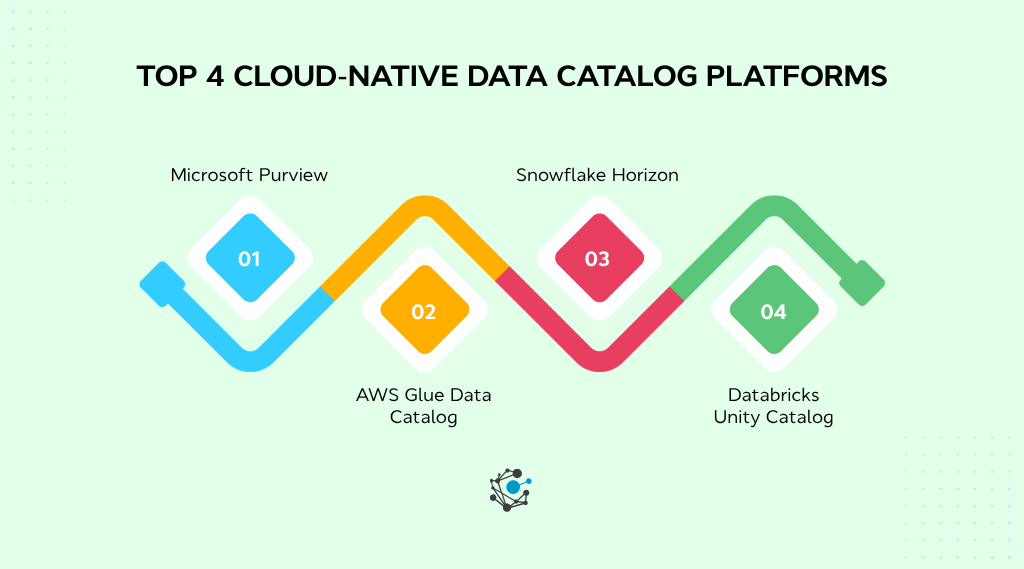
Cloud-native platform catalogs are built into the major cloud ecosystems. They are strongest when your data stack is already committed to a single cloud provider, because the catalog inherits the platform's security model, identity layer, and native service integrations. The trade-off is portability: these tools work best inside their own walls and thin out when you need to govern assets across multiple clouds or on-prem systems.
At OvalEdge, we believe platform-native catalogs solve discovery inside one cloud, but most enterprises run data across two or three clouds plus legacy systems. Cross-cloud governance is where standalone catalogs earn their place.
12. Microsoft Purview
 G2 rating: 4.7/5
Crawl / Curate / Consume: 8/10 / 7/10 / 6/10 (Total: 21/30)
Microsoft Purview is Microsoft's unified data governance solution in Azure. It brings cataloging, classification, and policy enforcement into the same environment where most Microsoft shops already manage identity, security, and compliance.
What does Microsoft Purview actually do that other data catalogs don't?
Its difference is native Microsoft coupling. Where a standalone catalog has to build connectors and inherit identity, Purview starts inside the ecosystem and uses infrastructure that Microsoft shops already run.
-
Native Azure integration: Deep coupling with Azure Synapse, Power BI, Microsoft 365, and Fabric without additional middleware.
-
Automated classification: ML-driven scanning that tags sensitive data and applies labels across the Microsoft ecosystem.
-
Data mapping: Visual representation of your data estate with automated discovery across Azure services.
-
Role-based access controls: Policy enforcement that inherits Azure Active Directory roles and permissions.
Crawl-Curate-Consume Fit:
-
Crawl: Very strong within Microsoft. Native services require relatively little onboarding.
-
Curate: Strong within Microsoft. Classification, labels, and access controls benefit from existing Microsoft infrastructure.
-
Consume: Moderate. Integration is convenient, but curation workflows are lighter than those of dedicated governance platforms.
Best for: Organizations embedded in the Microsoft Azure ecosystem that want governance without adding another vendor.
Limitations: Governance coverage thins out quickly for non-Microsoft data sources. Some users report a learning curve with the UI and limited curation workflows compared to standalone catalogs.
13. AWS Glue Data Catalog
G2 rating: 4.3/5
Crawl / Curate / Consume: 7/10 / 4/10 / 4/10 (Total: 15/30)
AWS Glue Data Catalog is AWS's serverless metadata store for data lakes and analytics. It acts as the central schema registry for Athena, Redshift, EMR, and Lake Formation, making it the default catalog for AWS-native teams.
What does AWS Glue Data Catalog actually do that other data catalogs don't?
The difference is that it isn't trying to be a full catalog. Glue is a serverless metadata store that plugs directly into AWS analytics services, and the value is in that fit rather than in governance depth.
-
Serverless metadata store: Automatic schema detection and storage with no infrastructure to manage.
-
Lake Formation integration: Centralized access control and fine-grained permissions for data lake assets.
-
Apache Hive compatibility: Works as a drop-in Hive Metastore replacement for Spark and Presto workloads.
-
Cross-service registry: Serves as the shared schema layer for Athena, Redshift Spectrum, and EMR.
Crawl-Curate-Consume Fit:
-
Crawl: Strong within AWS. Automatic discovery works well across core AWS analytics workloads.
-
Curate: Basic. Glue is primarily a metadata store rather than a full governance platform.
-
Consume: Basic. It supports technical schema discovery rather than broad business-user self-service.
Best for: Teams operating primarily within AWS that need a lightweight, serverless metadata layer for their data lake.
Limitations: Designed as a metadata store, not a full governance platform. Limited business glossary, no stewardship workflows, and minimal support for assets outside the AWS ecosystem.
14. Snowflake Horizon
G2 rating: 4.6/5
Crawl / Curate / Consume: 7/10 / 8/10 / 7/10 (Total: 22/30)
Snowflake Horizon is Snowflake's built-in governance layer, combining access policies, data classification, lineage, quality monitoring, and trust signals into the Snowflake platform. For teams already running analytics and AI workloads on Snowflake, Horizon adds governance without introducing another vendor.
What does Snowflake Horizon actually do that other data catalogs don't?
Its difference is that governance is enforced at the query engine, not layered on top of the warehouse. Where a standalone catalog sits beside Snowflake, Horizon lives inside it.
-
Native access policies: Row-level and column-level security, masking policies, and object tagging enforced at the Snowflake engine level.
-
Automated classification: ML-driven detection of sensitive data categories like PII and PHI across Snowflake tables.
-
Lineage tracking: Cross-account and cross-cloud lineage for tables, views, and downstream dashboards within the Snowflake ecosystem.
-
Data quality monitoring: Built-in quality checks and freshness signals that surface trust indicators alongside the data itself.
-
Snowflake Marketplace integration: Discovery and governance extend to shared and third-party datasets published through the Marketplace.
Crawl-Curate-Consume Fit:
-
Crawl: Strong within Snowflake. Discovery and classification are tightly integrated with Snowflake assets.
-
Curate: Strong. Engine-level policies, tagging, and quality monitoring provide substantial native governance.
-
Consume: Strong. Quality, freshness, and classification signals appear where analysts already work.
Best for: Teams running core analytics and AI workloads on Snowflake that want governance embedded in the query layer rather than managed in a separate tool.
Limitations: Governance coverage stops at the Snowflake boundary. Teams with significant assets in other warehouses, on-prem databases, or SaaS tools will still need a standalone catalog for cross-platform visibility.
15. Databricks Unity Catalog
G2 rating: 4.6/5
Crawl / Curate / Consume: 7/10 / 8/10 / 6/10 (Total: 21/30)
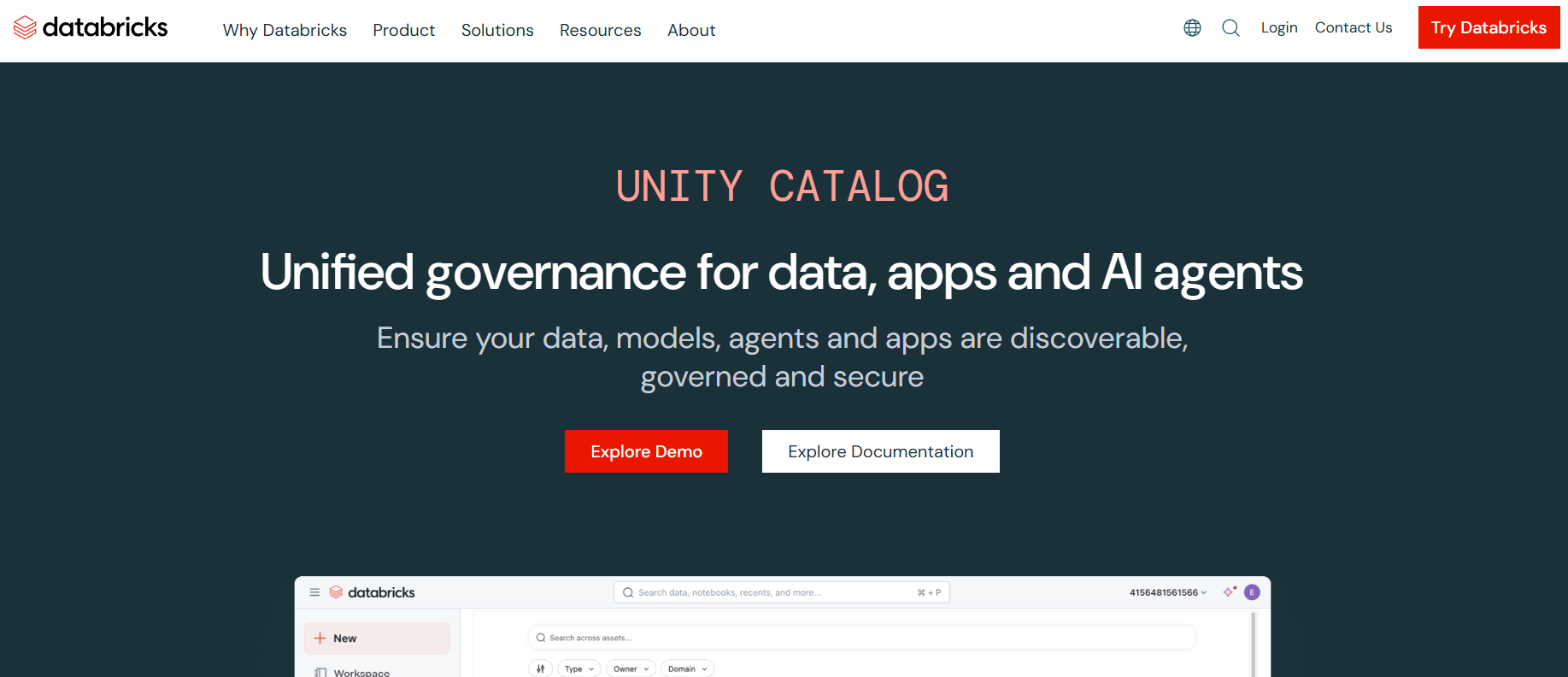
Unity Catalog is Databricks' unified governance layer for the lakehouse architecture. It provides centralized access control, lineage, and data discovery across all Databricks workspaces, with growing support for open formats like Apache Iceberg and Delta Lake. As catalogs increasingly serve as the context layer for AI agents, Unity Catalog's positioning at the intersection of analytics and ML governance makes it a significant market entrant.
What does Databricks Unity Catalog actually do that other data catalogs don't?
Its difference is governing data and AI assets in the same layer. Where most catalogs govern tables and treat ML models as an afterthought, Unity Catalog was built from day one to treat features, models, and datasets as first-class assets.
-
Unified namespace: One governance layer spanning tables, volumes, models, and functions across all Databricks workspaces.
-
Fine-grained access control: Row-level and column-level security enforced at the engine level, not just the catalog level.
-
Automated lineage: End-to-end lineage tracking across Spark jobs, SQL queries, and ML pipelines.
-
Open format support: Growing Iceberg and Delta Lake interoperability for multi-engine governance.
-
AI asset governance: Native tracking and governance for ML models, feature tables, and training datasets alongside traditional data assets.
Crawl-Curate-Consume Fit:
-
Crawl: Strong within Databricks. Data and AI assets can be inventoried under one governance layer.
-
Curate: Strong. Access controls, lineage, and ML asset governance support lakehouse environments.
-
Consume: Moderate. Strong for technical users, while broader business-user discovery remains less mature.
Best for: Lakehouse teams on Databricks that need unified governance across Spark, SQL, and ML workloads without adding another vendor.
Limitations: Strongest within Databricks. Cross-platform governance for non-Databricks engines (Trino, Flink) is improving but still maturing. Teams not on Databricks will find limited value.
Looking for open-source options?
If your team has engineering resources and wants full control over customization and infrastructure, open-source catalogs like DataHub, OpenMetadata, and Apache Atlas are worth evaluating. They trade vendor support and prebuilt workflows for flexibility and zero license costs.
We cover seven open-source platforms in detail, including architecture trade-offs and managed-service options, in our dedicated open-source data catalog tools guide.
How to choose the right data catalog for your team
Choosing a data catalog comes down to three things: matching the platform to your governance program, your data environment, and the timeline you can deploy against. The tool with the most features is rarely the right pick.
Here’s how to pick the right segment and tools according to your needs:
|
If your program looks like this |
Start with this segment |
Typical picks |
|
Multi-cloud or hybrid, moderate to regulated governance, needs to be live within 8 weeks |
Modern independents |
OvalEdge, Atlan |
|
Regulated industry, formal stewardship required, can resource a multi-quarter rollout |
Enterprise governance suites |
Collibra, Informatica IDMC, Alation |
|
Data lives inside one cloud; governance can inherit that cloud's identity layer |
Cloud-native catalogs |
Snowflake Horizon, Databricks Unity, Microsoft Purview |
Apply three filters to narrow your shortlist:
-
Deployment: Cloud-native tools take days or weeks. Modern independents take two to eight weeks. Enterprise suites take three to nine months.
-
Three-year TCO: Include add-ons for connectors, data quality, and AI governance, which can substantially increase base pricing.
-
Primary user: OvalEdge suits balanced cross-platform needs. Atlan and Alation favor business discovery. Collibra and Informatica favor formal stewardship.
Treat the operational footprint of an open-source catalog as part of its TCO. Supporting databases, search services, background workers, upgrades, and monitoring can offset the savings of a zero-license-cost platform.
Conclusion
Once you've narrowed the shortlist to two or three platforms, the last question is which one lets you move fastest without cutting governance.
OvalEdge is built for exactly this. Get governance, lineage, and AI-ready context in one platform, without the multi-quarter rollout of an enterprise suite or the single-cloud limits of a native catalog.
Want to see if OvalEdge fits your data stack? Book a data catalog demo and see how it holds up against your real data, real users, and real timeline.
.png?width=1081&height=173&name=Forrester%201%20(1).png)
.png?width=1081&height=241&name=KC%20-%20Logo%201%20(1).png)