
Agentic analytics extends traditional business intelligence by enabling autonomous systems to monitor data, interpret signals, and execute decisions within governed boundaries. It reduces decision latency, shifts analytics from passive reporting to active operations, and requires strong data foundations, consistent definitions, and auditability. Successful adoption layers autonomy on existing systems while maintaining human oversight, ensuring scalable, reliable, and controlled enterprise decision-making.
Most enterprise teams already have the pieces in place. Dashboards are built, data pipelines are running, and teams are expected to be data-driven. Yet the same problem keeps showing up in leadership reviews. Something changed in the business, but the response came too late. A revenue dip is noticed after the fact. A churn signal is investigated hours later. By the time a decision is made, the window to act has already narrowed.
The issue is not visibility. It is the gap between seeing a signal and doing something about it. That gap still depends on someone noticing the change, digging into the data, and deciding what to do next.
Agentic analytics is designed to close that gap. Autonomous agents continuously monitor data, interpret changes in context, and trigger actions or escalate decisions without waiting for a query. But this only works when the underlying data is governed. Without consistent definitions, clear lineage, and controlled access, agents act fast but not reliably.
This guide breaks down how agentic analytics works, where it adds value, and what needs to be in place before enterprises can trust it in production.
What is agentic analytics?
Agentic analytics is an approach to data intelligence where autonomous AI agents continuously monitor business signals, interpret changes in context, and take approved actions without waiting for a human to query a dashboard or run a report.
Unlike traditional business intelligence, which answers questions users already know to ask, agentic analytics surfaces insights proactively and routes them into decision workflows. The system operates within governance boundaries that define what data agents can access, what actions they can take, and what gets logged for audit and compliance.
The three continuous motions of agentic analytics
Unlike traditional analytics, which operates in discrete steps (query → analysis → decision), agentic analytics functions as a continuous system. At its core are three interconnected motions that run in parallel:
1. Continuous signal interpretation
Agentic systems constantly monitor data streams to detect changes, anomalies, or emerging patterns. Instead of waiting for users to query dashboards, the system identifies what matters as it happens.
2. Contextual understanding
Once a signal is detected, agents interpret it using business context such as metric definitions, historical patterns, and data lineage. This ensures that insights are not just technically correct, but aligned with how the business defines and uses data.
3. Decision execution within boundaries
After interpreting the signal, the system either recommends or takes action based on predefined policies. These actions operate within governance boundaries, ensuring that automation remains controlled, auditable, and aligned with business rules.
Together, these three motions transform analytics from a passive reporting function into an active decision system. Instead of stopping at insight generation, agentic analytics continuously moves from detection to interpretation to action, without waiting for manual intervention.
How analytics has evolved to agentic systems
This progression shows how analytics has shifted from manual reporting to autonomous decision-making. It also highlights where agentic analytics builds on existing BI investments rather than replacing them.
-
Manual SQL: Analysts queried databases directly to answer specific questions
-
BI dashboards: Data was visualized for reporting; humans interpreted results
-
Self-service BI: Business users explored data without relying on analysts
-
Augmented analytics: AI-surfaced insights and recommendations; humans still make decisions
-
Agentic analytics: AI agents act on insights autonomously, within defined governance boundaries
For a full breakdown of what agentic analytics delivers in practice, from decision latency to governance compliance, see OvalEdge’s analysis of the benefits of agentic analytics across enterprise functions.
How agentic analytics differs from chatbots and AI copilots
Most organizations already use AI tools like Copilot or chat-based analytics. This comparison clarifies what those tools do and where agentic analytics introduces continuous, governed decision-making.
|
Capability |
Chatbot / NLQ |
AI Copilot |
Agentic Analytics |
|
What it does |
Answers questions you ask |
Suggests next steps |
Acts on insights autonomously |
|
When it runs |
On demand |
On demand |
Continuously |
|
Human required |
Yes, to prompt |
Yes, to decide |
Minimal, reviews exceptions |
|
Governance built in |
No |
No |
Yes, actions are bounded and logged |
|
Best for |
Single queries |
Analyst productivity |
Enterprise decision automation |
Agentic Analytics vs Business Intelligence: what actually changes
While both business intelligence and agentic analytics work with the same underlying data, they operate very differently in how decisions are made and executed.
|
Capability |
Business Intelligence (BI) |
Agentic Analytics |
|
Primary function |
Reporting and visualization |
Continuous decision execution |
|
How it works |
Users query dashboards and interpret results |
Agents monitor data and act on signals automatically |
|
Timing |
Periodic or on-demand |
Real-time and continuous |
|
Decision ownership |
Human-driven |
Shared between AI and humans |
|
Actionability |
Insights require manual follow-up |
Actions are triggered within defined boundaries |
|
Governance role |
Applied to data access and reporting |
Embedded into decision-making and execution |
The shift from BI to agentic analytics is not about replacing dashboards with AI. It is a structural change in how decisions happen.
Why agentic analytics matter
The shift to agentic analytics is not just about faster insights or automation. It changes how decisions are made, and more importantly, who or what is responsible for making them. This is where human-AI collaboration becomes critical.
Where AI agents take over decision execution
In an agentic analytics system, AI agents take over continuous and repeatable decision processes. They monitor data streams in real time, detect anomalies or changes, and execute predefined actions within approved boundaries.
This includes tasks such as adjusting pricing, flagging fraud, routing operational alerts, or triggering workflow updates. These are decisions that require speed, consistency, and the ability to process large volumes of data without delay.
Where human judgment and oversight remain essential
Humans remain responsible for decisions that require judgment, context, and accountability. This includes defining strategy, handling edge cases, reviewing exceptions, and setting the policies that guide how agents operate.
Humans also play a critical role in governance oversight, ensuring that decisions align with business objectives, regulatory requirements, and ethical standards.
Why governance defines decision boundaries between humans and AI
The effectiveness of this collaboration depends entirely on how clearly the boundary between human and AI decision-making is defined. Without governance, agents may act on incomplete or misinterpreted data, while humans may not know when to intervene or override automated decisions.
A strong governance layer establishes what data agents can use, what actions they are allowed to take, and how every decision is tracked and audited. This creates a system where autonomy does not replace human control, but operates within it.
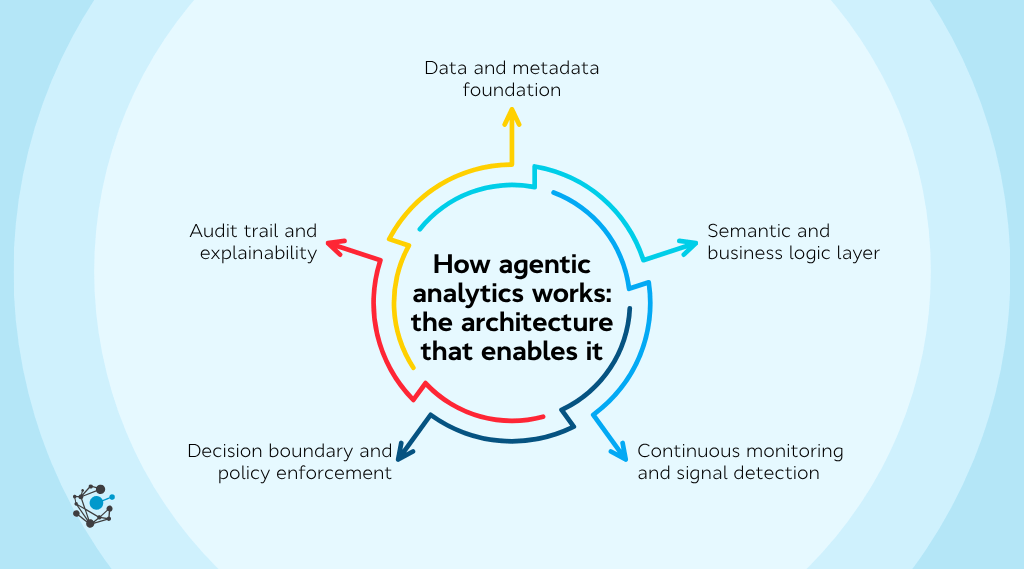
How agentic analytics works: The architecture that enables it
Agentic analytics is not a single capability. It is a system built on multiple interconnected layers that ensure AI agents can interpret data correctly, act within defined boundaries, and continuously improve decisions over time.
Each layer plays a specific role in making autonomous analytics reliable, scalable, and aligned with business context. Without this structure, agents operate on fragmented data, leading to inconsistent outputs and untrusted decisions.
1. Data and metadata foundation
Every agentic system starts with a clear understanding of the data it operates on. Agents need visibility into what data exists, what it represents, how it moves across systems, and who is responsible for it. This is enabled through a centralized enterprise data catalog and metadata layer.
Metadata provides definitions, ownership, lineage, and usage context. Without it, agents access raw datasets without business meaning, producing outputs that are technically correct but operationally misleading.
For example, analyzing sales data without regional adjustments or reporting context can lead to incorrect recommendations. The metadata layer ensures meaning travels with the data, allowing agents to operate with the same context as human analysts.
2. Semantic and business logic layer
Agents require consistent definitions to interpret data correctly. This layer standardizes how metrics and dimensions are defined across the organization.
In many enterprises, metrics such as revenue or churn vary across teams. If agents rely on conflicting definitions, their outputs will also conflict.
A governed business glossary ensures that agents use a single, agreed-upon interpretation. For instance, an agent optimizing marketing spend must rely on the same definition of conversion used to measure ROI. This layer ensures decisions remain consistent across functions.
3. Continuous monitoring and signal detection
Agentic systems continuously observe business signals rather than relying on scheduled reports. These signals include customer behavior, inventory changes, transaction patterns, and operational metrics.
Agents detect when signals cross thresholds or deviate from expected patterns, enabling proactive response. For example, they can identify demand spikes, detect unusual transactions, or flag operational delays in real time.
This shifts analytics from periodic reporting to always-on awareness, where decisions are triggered as events occur.
4. Decision boundary and policy enforcement
Autonomous decisions require clearly defined boundaries. This layer governs what agents can access, what actions they can take, and when escalation is required.
Policies define:
-
Data access permissions
-
Allowed actions
-
Escalation thresholds
-
Exception handling
Without these controls, agents may act in ways that are technically valid but misaligned with business or regulatory requirements.
For example, a pricing agent operates within approved ranges, while a fraud detection system may act automatically but escalate ambiguous cases. This ensures autonomy operates within control.
5. Audit trail and explainability
Every decision must be traceable. This layer captures what triggered the action, what data was used, what rules applied, and what outcome was produced.
Each decision is linked through data lineage, showing how data flowed from source to action. This is essential for compliance and internal accountability.
For example, when a transaction is flagged or pricing is adjusted, teams can trace the reasoning behind the action. This transparency turns automated decisions into explainable processes, making agentic analytics trustworthy at scale.
Agentic analytics vs traditional analytics
Agentic analytics shifts analytics from human-led reporting to system-driven decision execution, but a detailed comparison across speed, accuracy, scalability, and governance is covered separately. For a full breakdown of how agentic analytics differs from traditional BI systems in real-world enterprise environments, see our agentic analytics vs traditional BI comparison.
Why enterprises layer agentic analytics on top of BI
Most organizations do not replace business intelligence systems when adopting agentic analytics. They layer it on top.
BI continues to provide reporting, visibility, and historical analysis. Agentic analytics builds on this by continuously monitoring data, detecting signals, and triggering actions within defined governance boundaries.
| For example, at Bedrock, a governance-first data foundation was established before introducing automation. By standardizing definitions, enabling data lineage, and enforcing access controls, teams operated on consistent and trusted data. |
This led to:
-
Faster data discovery
-
Reduced manual analysis effort
-
More consistent reporting across teams
-
Improved confidence in decision-making
Layering allows enterprises to automate decisions without disrupting existing BI investments. Instead of replacing dashboards, it reduces reliance on them for time-sensitive decisions.
What agentic analytics looks like in practice
To understand how agentic analytics works in practice, it helps to look at a real operational scenario instead of abstract components.
Consider a retail team that has defined a rule: if the cart abandonment rate exceeds 15 percent within a two-hour window, the system should investigate and flag the issue.
When that threshold is breached, the agent immediately detects the anomaly and begins analyzing the underlying data. It pulls cart abandonment metrics and cross-references them with related datasets, including website performance logs, recent inventory updates, and pricing or promotion changes. Using data lineage, it traces how each dataset was generated and verifies that the inputs are reliable.
Within minutes, the agent identifies the root cause. In this case, a discount code stopped working 90 minutes earlier, directly impacting checkout completion rates.
The system then sends an alert to the merchandising lead through Slack. The alert includes the identified issue, supporting data, lineage of all sources accessed, and two recommended actions: reactivate the discount code or apply a temporary site-wide adjustment.
The merchandising lead approves one option. The agent executes the change and logs the entire decision process, including the trigger, analysis, approval, and action taken, creating a complete audit trail.
The entire process takes under five minutes. Without this system, identifying the same issue would typically require hours of manual investigation after a revenue drop is noticed.
Where agentic analytics delivers value: role-based use cases
Agentic analytics does not impact every team in the same way. Its value becomes clearer when viewed through the lens of specific roles and the decisions they are responsible for. Each role benefits from automation, but also introduces governance requirements that must be addressed upfront.
For data and analytics leaders
Agentic systems reduce repetitive, ad hoc analysis by handling common queries and pattern detection autonomously. This allows teams to focus on higher-value work such as data strategy and model design.
The key risk is metric drift. If different teams define metrics inconsistently, agent outputs will conflict. A governed business glossary and centralized data catalog ensure all agents operate on standardized definitions, keeping insights consistent across the organization.
For operations teams
Operations teams move from periodic reporting to continuous monitoring. Agents track KPIs in real time and trigger alerts or actions when thresholds are crossed.
The governance requirement is clear decision boundaries. Teams must define what agents can act on independently and where human approval is required. This ensures faster response without introducing operational risk.
For compliance and risk teams
In regulated environments, every automated decision must be traceable. Agentic systems introduce scale, but also increase the need for accountability.
Compliance teams require visibility into:
-
What triggered a decision
-
What data was used
-
What rules were applied
-
What action was taken
This is where auditability becomes critical. A built-in audit trail with data lineage ensures that every action can be reviewed, validated, and reported during regulatory checks.
For executives
Executives receive proactive summaries of performance, anomalies, and risks before reviews or meetings.
The challenge is trust. If outputs are inconsistent or unclear, adoption drops quickly. A governed data foundation ensures insights are reliable, explainable, and actionable at the executive level.
How to implement agentic analytics in your organization
Implementing agentic analytics is not just about deploying AI models. It requires a structured approach that ensures agents operate on the right data, within defined boundaries, and with full accountability. Most implementation failures happen not because of the models, but because the foundation is not in place.
.png?width=1024&height=569&name=How%20to%20implement%20agentic%20analytics%20in%20your%20organization%20(2).png)
Step 0: Establish your data foundation before deploying any agent
Before introducing any agent, organizations need to ensure that the underlying data environment is structured, governed, and traceable. This step is often skipped, but it determines whether agentic analytics produces reliable outcomes or inconsistent decisions.
Data Catalog: Agents need to know what data exists, what it represents, and how it flows across systems. A centralized data catalog with documented definitions, ownership, and lineage ensures that agents operate with business context, not just raw tables.
Governance Policy: Define what data agents can access, what actions they can take independently, and where human approval is required. These decision boundaries must be established before deployment to prevent uncontrolled automation.
Audit Infrastructure: Every automated action must be logged with a traceable record of inputs, rules, and outcomes. Building auditability upfront ensures compliance and makes agent-driven decisions explainable from day one.
Without this foundation, even the most advanced models will produce outputs that are difficult to trust or scale. The governance foundation most organizations miss is not complex to establish. Our guide to automated data governance explains how enterprises build this layer before introducing autonomous systems.
Step 1: Identify high-impact decision points
Instead of broad questions, focus on specific decision workflows where delays, manual effort, or inconsistency create measurable impact.
Look for:
-
Decisions that rely on repetitive analysis
-
Processes where response time directly affects outcomes
-
Areas where data exists but is underutilized
For example, identifying where analysts spend hours investigating the same type of issue repeatedly is a strong signal that the workflow can be automated with agents.
Step 2: Select tools that align with your data and governance model
Choosing the right platform is not just about AI capability. It is about how well the system integrates with your existing data architecture and governance requirements.
Evaluate tools based on:
-
Ability to integrate with your data sources and pipelines
-
Support for governed data access and policy enforcement
-
Capability to operate on real-time or near-real-time data
-
Flexibility to adapt models and workflows over time
The goal is not just to enable automation, but to ensure that automation operates within your organization’s control framework.
For a breakdown of the platforms delivering agentic analytics in production enterprise environments, see OvalEdge’s overview of agentic analytics tools.
Step 3: Define a controlled rollout strategy
Agentic analytics should not be deployed across the organization all at once. Start with a focused use case where the impact can be measured clearly.
A structured rollout includes:
-
Defined timelines for pilot and expansion
-
Cross-functional involvement from data, IT, and business teams
-
Clear ownership of agent behavior and outcomes
-
Success metrics tied to business impact, not just technical performance
This approach reduces risk while building confidence in how agents operate within real workflows.
Step 4: Integrate agents into existing workflows
The value of agentic analytics comes from how well it fits into day-to-day operations. Agents should augment existing processes, not disrupt them.
This involves:
-
Connecting agents to live data pipelines
-
Embedding outputs into tools teams already use, such as dashboards, alerts, or collaboration platforms
-
Automating repeatable actions while maintaining human checkpoints for critical decisions
Seamless integration ensures that insights and actions happen within the flow of work, not as a separate layer.
Step 5: Monitor, validate, and continuously improve
Once deployed, agentic systems require continuous oversight to ensure they remain accurate, relevant, and aligned with business goals.
Focus on:
-
Tracking decision accuracy and impact
-
Reviewing audit logs to validate behavior
-
Refining rules and models as conditions change
-
Incorporating feedback from users and stakeholders
Agentic analytics improves over time, but only when there is a feedback loop that connects performance back to governance and model refinement.
Challenges and limitations
While agentic analytics introduces faster decision-making and automation, its success depends on how well organizations manage the underlying risks. These challenges do not come from the technology alone, but from how it interacts with data, systems, and people.
1. Data quality and integrity issues
Agentic systems act on the data they receive. If that data is incomplete, inconsistent, or outdated, the system will scale those errors across decisions. Unlike traditional analytics, there is no manual checkpoint before action is taken.
To mitigate this, organizations need continuous validation, standardization, and monitoring of data pipelines. This is where data observability becomes critical, enabling early detection of issues before they impact decisions. OvalEdge’s data quality monitoring and lineage tracking flag integrity issues before agents act on compromised data, preventing downstream errors that are harder to reverse.
2. Integration challenges with existing systems
Many enterprises still rely on legacy systems that are not designed for real-time data processing. Without proper integration, agents operate on fragmented or siloed data.
This requires a unified data layer that connects sources across the ecosystem. OvalEdge’s connector ecosystem enables integration across data warehouses, pipelines, and enterprise applications, allowing agents to operate on governed, consistent data without replacing existing infrastructure.
3. Resistance to change and adoption barriers
Teams may hesitate to trust systems that automate decisions, especially when outcomes are not easily explainable. Concerns about job displacement can further slow adoption.
Clear communication, training, and positioning AI as an augmentation rather than a replacement are critical to building trust.
4. Error propagation in autonomous systems
When agents act on incorrect inputs or assumptions, errors can cascade across workflows before detection.
Governance controls such as validation checkpoints, decision boundaries, and audit trails are essential to contain and trace these failures.
5. Scalability in large-scale operations
As data volumes and decision complexity grow, systems must scale without losing performance or consistency.
This requires platforms where governance, data quality, and decision policies scale alongside automation.
Governance and oversight in agentic analytics
Agentic analytics allows systems to act on data continuously, but as decisions become autonomous, the focus shifts from speed to control. Governance is what makes that shift possible.
It is not a layer added after deployment. It is the foundation that defines how agents access data, interpret signals, and act within approved boundaries. Without governance, autonomy leads to inconsistency and risk. With it, organizations get reliable, repeatable decision-making at scale.
Why governance matters for agentic analytics
Agentic systems learn, adapt, and act with minimal human input. That autonomy introduces risks such as bias, misuse of data, and decisions that cannot be explained or audited.
Governance embeds structure into every decision through:
-
Transparency: Every action is traceable to its data, logic, and trigger
-
Fairness: Decisions rely on consistent, unbiased data and definitions
-
Accountability: Humans oversee high-impact or ambiguous scenarios
-
Compliance: Actions align with regulatory and organizational policies
These are operational requirements, not theoretical principles.
For a deeper look at how governance frameworks are being built specifically for AI systems, see OvalEdge's overview of AI data governance in enterprise environments.
Governance as the enabler, not the constraint
Agentic analytics is the engine. Governance is the guardrail that keeps it aligned with business intent. Without it, systems move fast but unpredictably. With it, speed translates into controlled execution.
This is what allows agentic systems to move from experimentation to production.
How governance works in practice
Governance becomes real when it is embedded into workflows:
-
When an agent adjusts campaign spend, it operates only on verified data and within approved thresholds
-
When a model recommends resource reallocation, governance validates lineage and business rules before execution
-
In regulated environments, such as healthcare or financial services, every automated decision is logged with full traceability, including data accessed, rules applied, and actions taken
These controls are built into the system from the start.
Governance connects data to meaning, decisions to accountability, and automation to control. This is what allows organizations to move from experimenting with AI to operationalizing it at scale. Without governance, agentic systems remain experimental. With it, they become reliable and production-ready.
Conclusion
Agentic analytics is not just a new layer on top of existing analytics systems. It represents a shift in how organizations operate, from systems that answer questions to systems that actively pursue outcomes.
The organizations that succeed with this shift are not the ones moving fastest. They are the ones who build the right foundation first. That foundation includes clearly defined data, consistent business logic, governed access, and complete auditability for every decision made.
Without this, even the most advanced agentic systems produce outputs that appear correct but cannot be trusted over time. Decisions become difficult to explain, inconsistencies emerge across teams, and confidence in the system declines.
With a governed data foundation in place, agentic analytics becomes reliable and scalable. Each decision improves the next because it is built on consistent definitions, traceable data, and controlled execution. This is what turns automation into a long-term advantage rather than a short-term experiment.
askEdgi by OvalEdge brings governed agentic analytics to the enterprise by combining conversational AI with a trusted, cataloged, and lineage-tracked data foundation.

Book a demo to see how it works within your environment and how your teams can move from reactive analysis to controlled, autonomous decision-making.
FAQs
1. What is the difference between agentic analytics and AI in BI tools?
AI in BI tools assists with insights and queries, but humans still make decisions. Agentic analytics continuously monitors data, detects changes, and executes actions within governance boundaries, shifting analytics from supporting decisions to actively participating in them.
2. How do teams evaluate agentic analytics platforms alongside existing BI systems?
Teams evaluate platforms based on integration with BI, ability to use governed data, real-time monitoring, decision boundaries, auditability, and workflow compatibility. The goal is to extend BI with controlled automation, not replace it.
3. What governance needs to be in place before adopting agentic analytics?
Organizations need a data catalog, consistent metric definitions, data lineage, access controls, and audit logs. This foundation ensures agents operate on trusted data, follow defined rules, and produce reliable, explainable decisions.
4. Can agentic analytics work alongside traditional BI tools?
Yes, agentic analytics is typically layered on top of BI. BI supports reporting and exploration, while agentic systems monitor data continuously and trigger actions, improving decision speed without replacing existing tools.
5. What are the main risks of agentic analytics?
Key risks include poor data quality, lack of transparency, and uncontrolled automation. Without governance, systems may act on incorrect data. These risks are mitigated through validation, decision boundaries, and full auditability of automated actions.
6. How does agentic analytics work in regulated industries like finance or healthcare?
Agentic systems log data sources, rules, and actions behind every decision. This ensures traceability, compliance, and accountability, enabling organizations to meet regulatory requirements while benefiting from real-time, automated decision-making.
Deep-dive whitepapers on modern data governance and agentic analytics
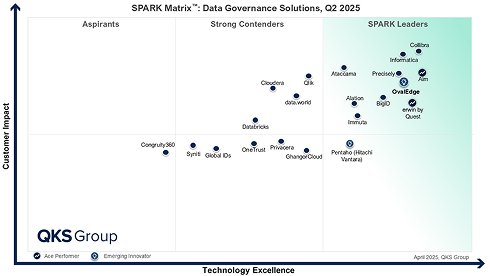
OvalEdge Recognized as a Leader in Data Governance Solutions
.png?width=1081&height=173&name=Forrester%201%20(1).png)
“Reference customers have repeatedly mentioned the great customer service they receive along with the support for their custom requirements, facilitating time to value. OvalEdge fits well with organizations prioritizing business user empowerment within their data governance strategy.”
.png?width=1081&height=241&name=KC%20-%20Logo%201%20(1).png)
“Reference customers have repeatedly mentioned the great customer service they receive along with the support for their custom requirements, facilitating time to value. OvalEdge fits well with organizations prioritizing business user empowerment within their data governance strategy.”
Gartner, Magic Quadrant for Data and Analytics Governance Platforms, January 2025
Gartner does not endorse any vendor, product or service depicted in its research publications, and does not advise technology users to select only those vendors with the highest ratings or other designation. Gartner research publications consist of the opinions of Gartner’s research organization and should not be construed as statements of fact. Gartner disclaims all warranties, expressed or implied, with respect to this research, including any warranties of merchantability or fitness for a particular purpose.
GARTNER and MAGIC QUADRANT are registered trademarks of Gartner, Inc. and/or its affiliates in the U.S. and internationally and are used herein with permission. All rights reserved.