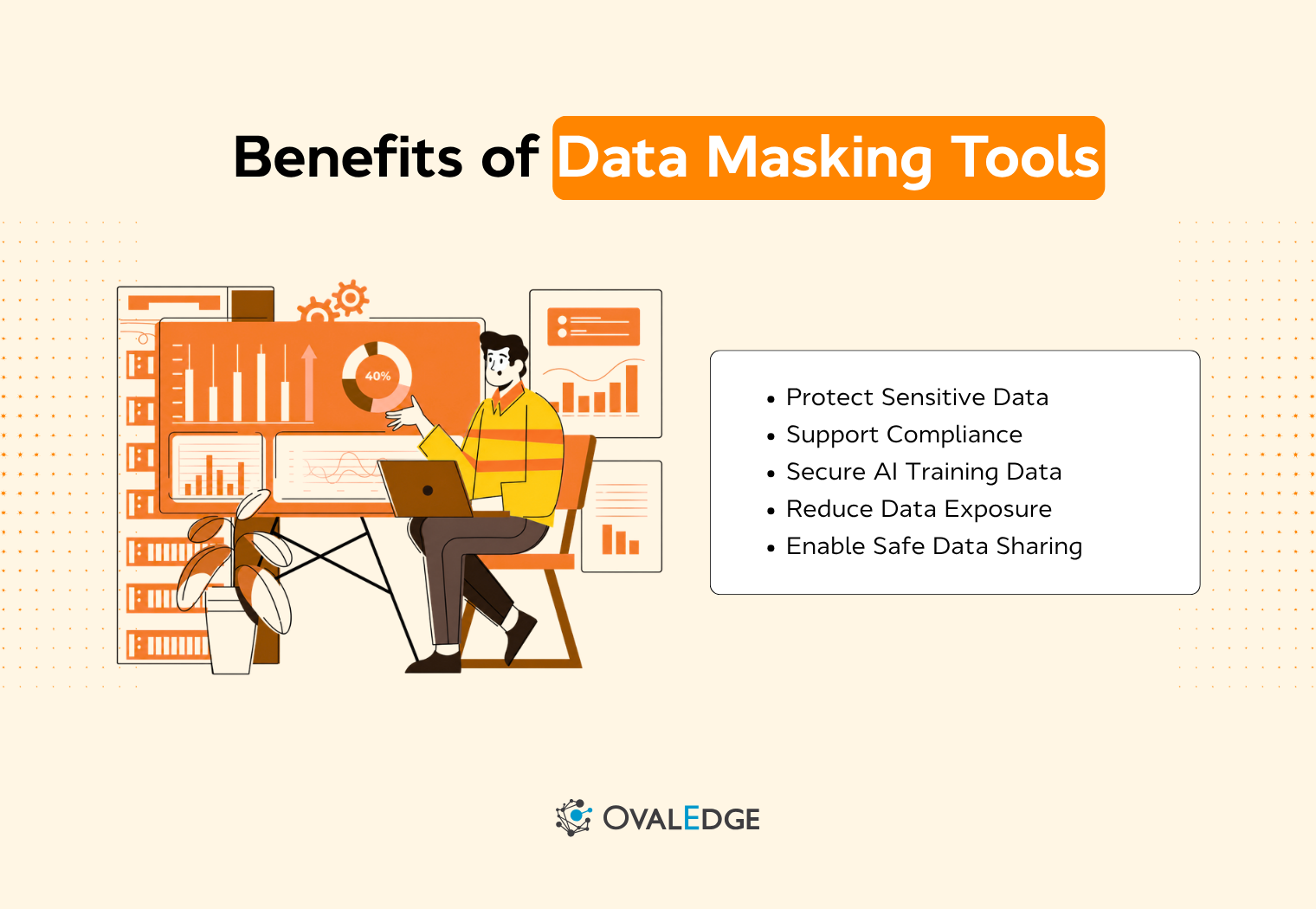
Enterprise AI programs now pull customer records, payment data, and health information into training sets, test environments, and inference paths. Compliance pressure is stacking on the same datasets, with GDPR, HIPAA, PCI DSS, and EU AI Act obligations overlapping on a single table.
Covering discovery, masking, and governance for that data often takes three separate vendors and months of integration work, and a single unclassified column can slip through unmasked.
The 12 data masking tools below are compared on masking types, compliance coverage, governance integration, and pricing. Each entry also shows the stack, regulation, and AI workload it fits best.
Data masking tools at a glance
The table below compares all 12 data masking tools on the masking types each one supports, where it runs, the regulations it addresses, how closely it connects to governance, and what it costs to get started.
|
Tool |
Masking types |
Deployment |
Compliance coverage |
Governance integration |
Starting price |
|
OvalEdge |
Static, dynamic, on-the-fly |
SaaS, customer cloud, on-prem, hybrid |
GDPR, CCPA, HIPAA, AI Act |
Native: catalog, lineage, classification, and access policies in one platform |
|
|
Informatica |
Static, dynamic |
Cloud, hybrid |
GDPR, HIPAA, PCI DSS, CCPA |
Informatica governance and catalog suite |
|
|
Delphix (Perforce) |
Static, deterministic |
Cloud, on-prem |
GDPR, HIPAA, PCI DSS, CCPA |
API-level, no native catalog |
|
|
K2view |
Static, dynamic |
Cloud, on-prem |
GDPR, HIPAA, PCI DSS, DORA |
Built-in discovery and catalog |
|
|
IBM InfoSphere Optim |
Static |
On-prem, cloud |
GDPR, HIPAA, PCI DSS |
Separate IBM governance tooling |
|
|
Oracle Data Masking and Subsetting |
Static, format-preserving |
On-prem, Oracle Cloud |
GDPR, HIPAA, PCI DSS |
Oracle Enterprise Manager, Oracle-only |
|
|
Microsoft SQL Server and Azure SQL DDM |
Dynamic |
SQL Server 2016+, Azure SQL |
Supports GDPR and HIPAA controls, no compliance templates |
Microsoft Purview (separate) |
|
|
Immuta |
Dynamic |
SaaS, self |
GDPR, HIPAA, CCPA |
Connects to external catalogs |
|
|
Tonic.ai |
Static, synthetic |
Cloud, self-hosted |
GDPR, HIPAA, CCPA |
Minimal |
|
|
IRI FieldShield |
Static, dynamic |
On-prem, cloud |
GDPR, HIPAA, PCI DSS, CCPA |
Built-in classification only |
|
|
Salesforce Data Mask & Seed |
Static |
Salesforce sandboxes |
GDPR, CCPA |
Salesforce |
|
|
DATPROF |
Static, subsetting |
On-prem, cloud |
GDPR, HIPAA |
Minimal |
Types of data masking
Before comparing the tools in detail, identify the type of masking your use case requires. The table above lists static, dynamic, on-the-fly, and deterministic masking, but each protects data at a different point. Knowing the difference will help you narrow the 12 tools to the ones that fit your environment.
-
Static data masking: Creates a permanently masked copy of production data. It suits test, development, and AI training datasets, and tools like Delphix, IBM InfoSphere Optim, and DATPROF specialize in it.
-
Dynamic data masking: Hides sensitive fields at query time based on the user's role, while the source data stays unchanged. Production analytics and AI inference access depend on it, with Microsoft SQL Server DDM and Immuta as common examples.
-
On-the-fly data masking: Protects data in transit as it moves between systems. ETL pipelines and cloud migrations use it to keep unmasked values out of the destination, a strength of K2view and Informatica.
-
Deterministic data masking: Maps the same input to the same masked output every time. Joins and keys stay intact across databases, which makes it the right fit for multi-system test data in Delphix, K2view, or Tonic.ai.
Many teams combine two types, such as static masking for test copies and dynamic masking for production analytics. Within each type, the choice of data masking techniques, such as substitution, shuffling, or nulling, decides how realistic the masked output looks.
With the masking type in mind, you can now compare how each tool handles your data, systems, and compliance needs.
The 12 best data masking tools for 2026
The 12 best data masking tools for 2026 are OvalEdge, Informatica, Delphix, K2view, IBM InfoSphere Optim, Oracle Data Masking and Subsetting, Microsoft SQL Server and Azure SQL Dynamic Data Masking, Immuta, Tonic.ai, IRI FieldShield, Salesforce Data Mask & Seed, and DATPROF. Each tool below is profiled on the same five fields, so the differences show up in a single scan.
1. OvalEdge
OvalEdge is a unified data governance platform that uses AI-guided classification to decide what gets masked across 170+ connected systems. Its Sift agent detects PII, PHI, financial, and custom sensitive categories and applies the governance policies tied to each tag, so masking rules follow the data across Snowflake, Databricks, and SQL Server.
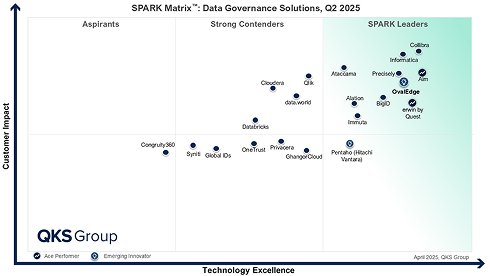
OvalEdge is recognized in the 2025 Gartner Magic Quadrant for Data and Analytics Governance Platforms and named a Leader in the 2025 SPARK Matrix for Data Governance Solutions.
G2 rating: 5/5
How it protects data: Masking policies attach to classifications as soon as sensitive columns are tagged. Role-based dynamic masking hides values at query time, and classifications sync to Snowflake so tag-based enforcement runs natively in the warehouse. Column-level lineage shows every downstream table, report, and dashboard that inherits a masked field.
Customers in a Forrester Total Economic Impact study of OvalEdge reported reduced effort in finding, tagging, and securing sensitive data, with a 337% ROI.
Where it delivers value:
-
One set of masking policies governs every connected system, and each rule traces back to its classification for audits.
-
Analysts and AI agents work with data that is already classified and masked, through the Enterprise Context Graph.
-
AskEdgi keeps self-service analytics inside masking rules when business users query data in plain language.
Compliance coverage: GDPR, CCPA, HIPAA, and the EU AI Act, with privacy workflows for data subject access requests (DSARs), records of processing activities (ROPA), and audits.
Watch-outs: OvalEdge is a full governance platform, so teams that only need a quick masked test copy may find it broader than the job requires. Synthetic data generation is outside its scope.
2. Informatica
Informatica Cloud Data Masking runs inside Informatica Intelligent Data Management Cloud (IDMC), and Informatica itself has been part of Salesforce since the acquisition closed in November 2025. It masks sensitive fields for non-production copies using built-in rules for Social Security numbers, credit cards, emails, and phone numbers, and it pairs with Informatica's access governance for dynamic masking down to individual rows and columns.
G2 rating: 4.1/5
How it protects data: Masking tasks apply field-level rules such as dictionary substitution, key masking, and random masking, then write masked data in place or to a separate target. Key masking returns the same output for the same input and seed, and subsets keep the source's foreign key relationships, so masked test data still joins correctly.
For production access, dynamic masking policies enforce least privilege and role-based controls at the row and column level.
Where it delivers value:
-
Teams already on IDMC mask, subset, and move data in the same platform that runs their integration pipelines.
-
Prebuilt rules for common identifiers shorten setup for PII and payment data.
-
Repeatable key masking and relationship-aware subsets keep test cases working after masking.
Compliance coverage: GDPR, CCPA, and HIPAA, with built-in credit card masking rules that support PCI DSS programs.
Watch-outs: The masking payoff is highest for teams already invested in IDMC, since standalone buyers take on a broad platform to get it. Consumption-based IPU pricing also makes costs hard to forecast before a pilot.
3. Delphix (Perforce)
Perforce Delphix combines data masking with data virtualization, so DevOps teams get masked, production-like copies without waiting on manual provisioning. It discovers sensitive data across databases, data warehouses, data lakes, and files, on-premises or in the cloud, and masks it with prebuilt algorithms that need no programming.
G2 rating: 4.1/5
How it protects data: Built-in and custom classifiers flag PII such as names, emails, and payment details, and masking algorithms replace them with realistic values. The same value masks the same way within and across sources, so referential integrity holds when test data spans several databases. Virtualization then delivers masked copies to downstream environments, reducing storage and wait time for each new environment.
Where it delivers value:
-
CI/CD pipelines pull fresh masked data through APIs, keeping privacy controls inside the release process.
-
Consistent masking across Oracle, SQL Server, and flat files keeps multi-system test cases working.
-
Virtual copies let many teams share masked data without multiplying storage.
Compliance coverage: GDPR, CCPA, HIPAA, and PCI DSS.
Watch-outs: Delphix focuses on static masking for non-production data, so masking live production queries needs a separate tool. The virtualization engine also adds infrastructure to run, which is more than teams need for occasional one-off copies.
4. K2view
K2view masks data at the business-entity level: it gathers every record tied to one customer, order, or device across systems and masks them together. It covers static, dynamic, and in-flight masking from one platform, plus reversible pseudonymization and tokenization for controlled access.
G2 rating: 4.6/5
How it protects data: Discovery scans both metadata and data content, using rules and large language models (LLMs) to classify sensitive fields. Masking rules apply to the whole business entity and run the same way across every source, so a customer masked in the CRM matches the same customer in billing and support systems. Policies are defined once in a central catalog and enforced across structured data and unstructured files such as PDFs, documents, and images.
Where it delivers value:
-
Entity-level masking keeps referential integrity intact across dozens of systems, where row-by-row tools tend to break.
-
One platform provisions masked data for testing, analytics, B2B data sharing, and AI workloads.
-
Compliance-ready reports come out of the box to support audits.
Compliance coverage: GDPR, HIPAA, PCI DSS, and DORA.
Watch-outs: The entity model needs upfront design work to define business entities before masking runs. K2view is also a broad data product platform, which is heavier than teams need for single-database masking.
5. IBM Optim (InfoSphere Optim)
IBM Optim combines data masking, test data management, and archiving for large, regulated estates that run on mainframes and long-lived enterprise applications. IBM released Optim 2.0 in July 2026, adding single-pass provisioning across systems and masking that keeps the same customer ID consistent in Oracle and Db2.
G2 rating: 4.6/5
How it protects data: Prepackaged masking routines, obfuscation, and format-preserving encryption (FPE) with AES-256 keys replace sensitive values while keeping formats and referential integrity intact. Predefined privacy classifications and rules speed up setup for regulated data. For dynamic use cases, a stand-alone API and user-defined functions (UDFs) apply masking at access time.
Where it delivers value:
-
Mainframe and z/OS shops mask Db2, Oracle, and PeopleSoft data from one tool.
-
Masking, subsetting, and archiving run under one policy engine, from test copies to compliant disposal.
-
Right-sized, referentially intact test data cuts storage and testing costs for large applications.
Compliance coverage: HIPAA, GLBA, and PIPEDA through predefined privacy classifications and rules.
Watch-outs: IBM's platform list centers on Oracle, Db2, PeopleSoft, and z/OS, so cloud-native teams should confirm connector coverage for their warehouses before shortlisting. The suite is also heavier than mid-size teams usually need.
6. Oracle Data Masking and Subsetting
Oracle Data Masking and Subsetting discovers, masks, and subsets sensitive data for non-production test, development, and analytics environments, with ready-made templates for Oracle E-Business Suite and Fusion Applications. On Oracle Cloud, Oracle Data Safe is included with Autonomous AI Database and brings the same masking to cloud databases with more than 50 built-in masking formats.
G2 rating: 4.5/5
How it protects data: Discovery classifies sensitive columns and maps referential relationships, so masking keeps formats and joins intact. Masking runs either in-database or during export, which removes the need for a separate staging environment. Subsetting then produces smaller, representative datasets that save time and storage.
Where it delivers value:
-
Oracle E-Business Suite and Fusion Applications teams start from prebuilt masking templates.
-
In-export masking keeps unmasked copies out of staging entirely.
-
Subsetting shrinks large Oracle databases into test sets that still behave like production.
Compliance coverage: GDPR and PCI DSS, with audit support for data protection by design and default.
Watch-outs: Oracle Data Masking and Subsetting performs best in Oracle-centric estates, and non-Oracle databases are reached through Oracle Database Gateways. Teams with data spread across Snowflake, Databricks, and SQL Server will need a platform-agnostic tool to keep masking consistent.
7. Microsoft SQL Server and Azure SQL Dynamic Data Masking
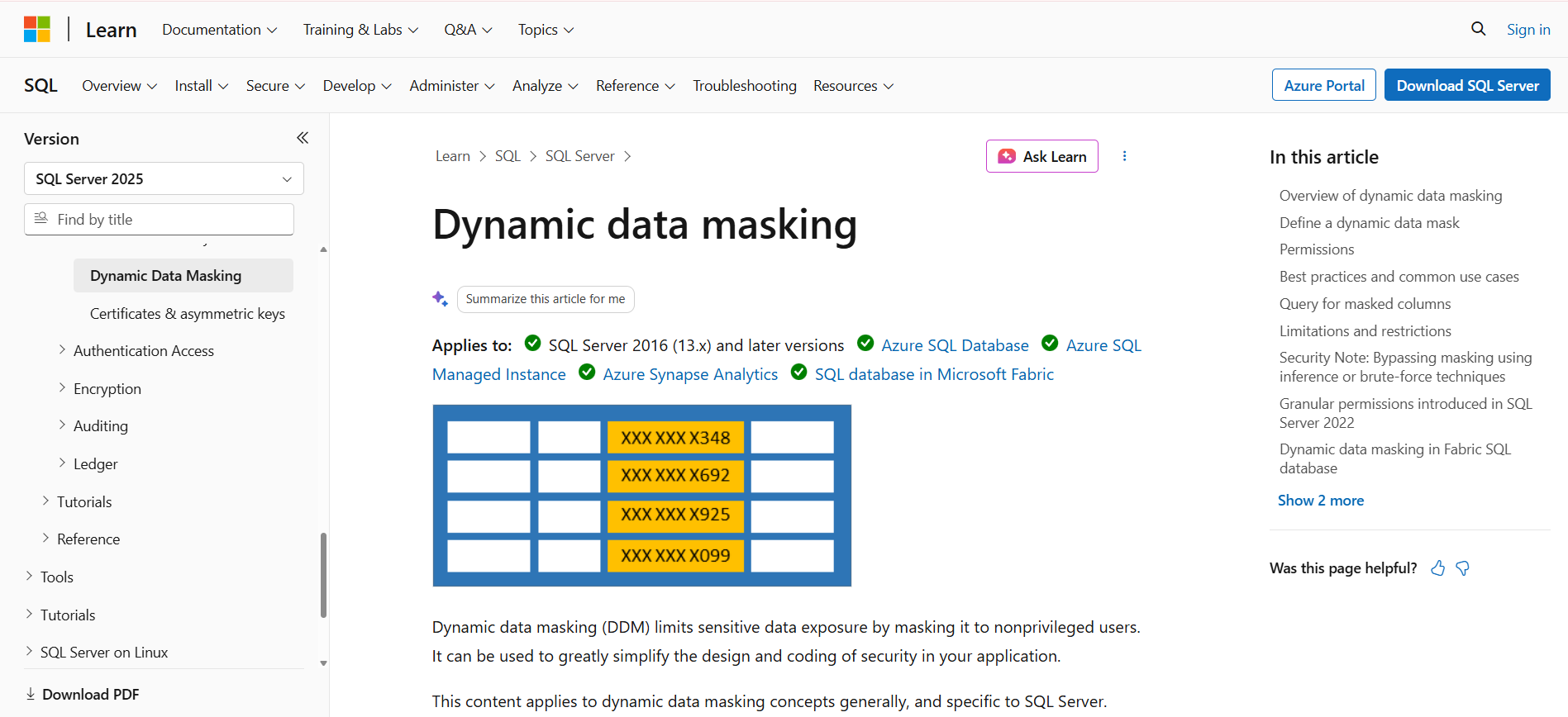
Dynamic Data Masking (DDM) is built into SQL Server 2016 and later, Azure SQL Database, Azure SQL Managed Instance, Azure Synapse Analytics, and SQL database in Microsoft Fabric. It hides sensitive columns in query results based on who is asking, and the stored data never changes. Because DDM comes with the database, it is the quickest way for SQL Server teams to start masking, and the Azure portal's recommendations engine flags likely sensitive columns to mask first.
How it protects data: A masking policy defines which columns to mask, which masking function to use, and which users see unmasked values. Built-in functions cover full masking, credit card numbers, emails, random numbers, custom text, and date parts. Granular UNMASK permissions can be granted at the column, table, schema, or database level.
Where it delivers value:
-
Masking runs natively in SQL Server and Azure SQL at no extra license cost.
-
UNMASK permissions line up with job roles, from support agents to finance leads.
-
Masking happens in query results, so applications keep working with minimal changes.
Compliance coverage: No built-in compliance templates or reports. Microsoft positions DDM as one control alongside auditing, encryption, and row-level security within wider GDPR, HIPAA, or PCI DSS programs.
Watch-outs: Admin roles such as sysadmin and db_owner always see unmasked data, and users with ad hoc query access can infer masked values through repeated filtered queries. DDM also creates no masked copies for test environments and covers only Microsoft SQL platforms.
8. Immuta
Immuta describes itself as the authorization layer for data access, with one set of policies deciding every data request from people and AI agents. It enforces dynamic masking natively inside cloud platforms such as Snowflake and Databricks, using attribute-based rules and sensitive data tags.
G2 rating: 4.3/5
How it protects data: Discovery tags sensitive columns, such as PII or person names, and masking policies attach to those tags. Masking types include NULL, hashing, constants, regex, and format-preserving masking, with privacy-enhancing techniques like dynamic k-anonymization for high-risk data. Attribute-based conditions decide who sees what, for example, masking tagged columns for everyone except members of an approved group.
Where it delivers value:
-
A small set of tag-driven policies replaces hundreds of per-table rules.
-
Non-technical governance teams can write and manage masking policies themselves.
-
Agentic Data Access grants AI agents short-lived, task-scoped access under the same rules.
Compliance coverage: GDPR, HIPAA, and CCPA, with prebuilt HIPAA and CCPA policies for Databricks.
Watch-outs: Immuta masks data at query time inside the platforms it enforces on, so it produces no masked copies for test environments. Its value depends on the stack running on those supported cloud platforms.
9. Tonic.ai
Tonic Structural de-identifies, subsets, and synthesizes structured and semi-structured data so engineering teams can build and test with realistic data that contains no real PII or PHI. It connects natively to databases, warehouses, and file stores such as PostgreSQL, Oracle, MongoDB, Snowflake, BigQuery, and Amazon S3, and runs self-hosted or in Tonic's cloud.
G2 rating: 4.2/5
How it protects data: Automated discovery detects PII and PHI, and custom rules catch sensitive types unique to the organization. Masking, tokenization, generalization, scrambling, and format-preserving encryption then transform the data consistently, preserving primary and foreign key relationships across complex schemas. Patented subsetting produces coherent datasets that are orders of magnitude smaller than production.
Where it delivers value:
-
Developers get production-like test data without waiting on manual scrubbing.
-
Consistent transformations keep joins and test cases working across environments.
-
Sibling products Tonic Textual and Tonic Fabricate extend coverage to unstructured text and synthetic data for AI work.
Compliance coverage: HIPAA, including Safe Harbor methods for de-identifying PHI.
Watch-outs: Tonic focuses on non-production data, so it does not mask live production queries or govern access by role. Tonic Structural has no free tier, and pricing is by custom quote.
10. IRI FieldShield
IRI FieldShield masks structured and semi-structured data across files, databases, spreadsheets, JSON, XML, mainframe files, and cloud storage, all designed and run from the Eclipse-based IRI Workbench. Its companion product, IRI DarkShield, extends the same protection to unstructured sources such as documents, PDFs, and images.
G2 rating: 4.5/5
How it protects data: Central classification rules find PII across sources, then mask it automatically with functions such as encryption, pseudonymization, redaction, hashing, tokenization, scrambling, and randomization. Deterministic functions preserve referential integrity, and reversible options such as field-level encryption keep controlled re-identification possible. Masking runs in static, dynamic, and real-time modes, either as batch jobs or inside ETL, migration, and subsetting workflows.
Where it delivers value:
-
Mid-market teams get broad masking coverage at a predictable, perpetual license cost.
-
One tool masks flat files, databases, message queues, and APIs in the same job.
-
Search reports, job audit logs, and re-identification risk scores give auditors verification evidence.
Compliance coverage: GDPR, HIPAA, PCI DSS, PIPEDA, POPIA, India's DPDPA, and SOC 2.
Watch-outs: Job design in IRI Workbench and scripting suits technical teams more than business users. FieldShield also has no catalog or data lineage, so governance context has to come from other tools.
11. Salesforce Data Mask & Seed
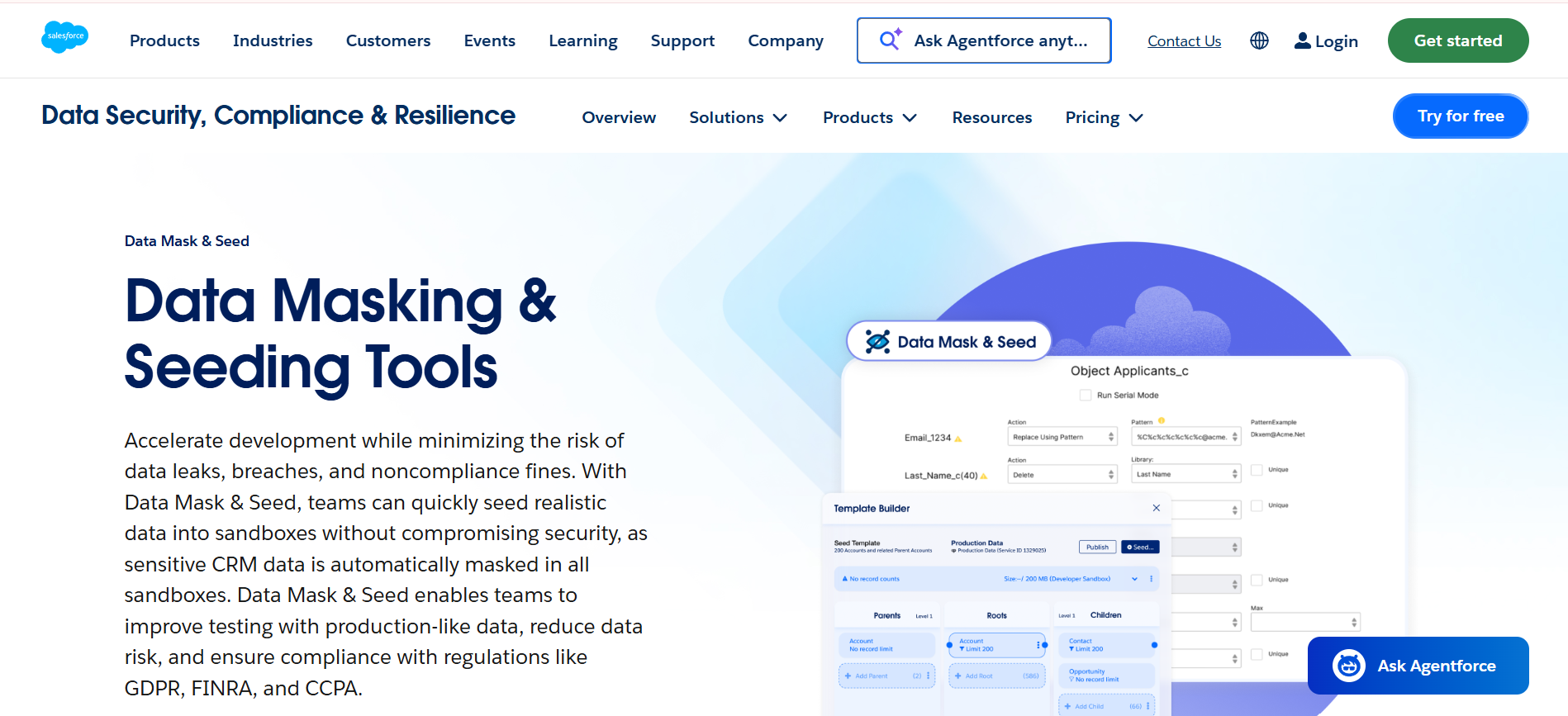
Salesforce Data Mask & Seed masks sensitive data in Salesforce sandboxes and seeds them with realistic records, so developers, testers, and trainers never work with live customer data. It runs on-platform across Developer, Developer Pro, Partial, and Full sandboxes, and jobs can be scheduled daily, weekly, or monthly.
How it protects data: Masking replaces private fields with random characters, similarly mapped words, or pattern-based values, or deletes the data outright. Uniform masking can apply across data classification categories, so every field tagged as PII gets the same treatment. Seed templates filter specific records and replicate production data relationships in smaller sandboxes.
Where it delivers value:
-
Salesforce teams mask sandbox data without exporting it to a third-party tool.
-
Seed templates stand up realistic, relationship-intact test orgs quickly.
-
Jobs can bypass automations, so masking and seeding runs don't trigger flows or triggers.
Compliance coverage: GDPR, CCPA, HIPAA, and FINRA.
Watch-outs: Data Mask & Seed covers Salesforce sandboxes only and never masks the production org. Pricing is 10% of net Salesforce spend, which scales with the overall contract rather than masking usage.
12. DATPROF
DATPROF is a test data management platform built around masking and subsetting non-production databases, with self-service provisioning and CI/CD integration for development and QA teams. It supports Oracle, SQL Server, DB2, PostgreSQL, MySQL, and other major databases, and DATPROF Privacy is optimized to mask databases holding terabytes of data.
G2 rating: 4.5/5
How it protects data: DATPROF Privacy shuffles, scrambles, or blanks sensitive columns and generates synthetic replacements such as new national ID or bank account numbers. Masked data keeps the characteristics of the original, so test results stay predictable. DATPROF Subset then cuts production databases down to smaller, representative test sets, and DATPROF's analysis tools map dependencies across the data environment before masking runs.
Where it delivers value:
-
Developers and testers request masked test data themselves through a self-service portal.
-
CI/CD integration automates test data refreshes inside release pipelines.
-
A published entry price makes budgeting straightforward for mid-size teams.
Compliance coverage: GDPR, through depersonalized development, test, acceptance, and production (DTAP) environments.
Watch-outs: DATPROF focuses on non-production databases, so it offers no dynamic masking of production queries or unstructured file coverage. Its compliance messaging centers on GDPR, so HIPAA or PCI DSS programs should confirm fit during evaluation.
Open-source data masking tools
Open-source data masking tools such as Greenmask, PostgreSQL Anonymizer, ARX, and Faker cost nothing to license, and each fits a narrower job than the commercial platforms above.
-
Greenmask: An Apache-2.0 utility that dumps, masks, subsets, and restores databases, with deterministic transformations that give the same output for the same input. It is production-ready for PostgreSQL, while MySQL support is still in beta.
-
PostgreSQL Anonymizer: A PostgreSQL extension where developers declare masking rules directly in the table definition, with static masking, dynamic masking, and anonymized dumps. It works only inside PostgreSQL.
-
ARX: An anonymization tool with a desktop GUI and Java library that applies privacy models such as k-anonymity and differential privacy and scores re-identification risk. It suits analytics and research datasets more than test database pipelines.
-
Faker: An MIT-licensed Python library that generates realistic fake names, addresses, emails, and phone numbers, with seeding for repeatable output. It creates replacement values, so teams still write their own code to find and swap sensitive fields.
Open-source tools need in-house engineering to run, audit, and maintain, and most lack centralized discovery, policy management, and audit reporting. DataVeil often appears in open-source lists, but it is commercial software that offers a free Community License tier.
How to choose the right data masking tool
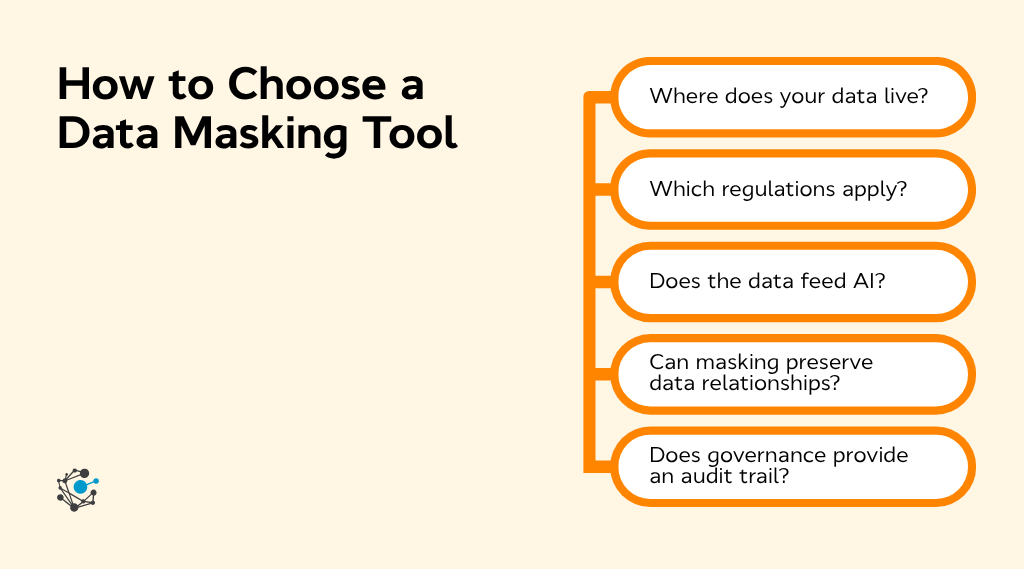
The right data masking tool depends on where the data lives, which regulations apply, and whether the data feeds AI. Answering those three questions first narrows the list quickly.
Start with three questions
-
Where does the data live? Snowflake and Databricks point to OvalEdge or Immuta, SQL Server to Microsoft DDM, Oracle to Oracle Data Masking and Subsetting, mainframes to IBM Optim, and Salesforce to Data Mask & Seed. Estates that span many platforms need one set of rules everywhere, which OvalEdge, K2view, and Informatica provide.
-
Which regulations apply? A GDPR data masking program needs proof of what is masked in every copy, so classification and audit reporting matter most. HIPAA teams can shortlist Tonic.ai or IBM Optim, and PCI DSS teams can look at IRI FieldShield or Informatica.
-
Does the data feed AI? Training sets need static or synthetic masking from tools such as Tonic.ai or K2view. AI agents and inference need dynamic masking that decides what each user or agent sees, a strength of Immuta and OvalEdge.
Six things to check
-
Sensitive data discovery: The tool should find and tag PII and PHI automatically. Hand-listed columns miss new tables.
-
Referential integrity: Keys and joins must stay consistent across databases, or test cases break after masking.
-
Coverage: One policy should apply across every platform, since separate rules for each system drift over time.
-
Performance: Masking should run at the source within the refresh window, without copying data to a staging server first.
-
Governance and audit: Every masking rule should trace back to the catalog and lineage, so audits don't need a rebuilt trail.
-
Pricing: The cost model should be clear before a pilot and predictable at renewal.
Conclusion
The right data masking tool lets teams test, analyze, and train AI models on realistic data without exposing real customer records. A good choice means fewer compliance gaps, faster test cycles, and audits backed by a clear record of what was masked, where, and why.
OvalEdge delivers that value from one governed layer. The Sift agent classifies PII, PHI, and financial data automatically, masking policies follow those classifications across Snowflake, Databricks, and SQL Server, and Notary recommends certification so teams know which datasets they can trust. The Enterprise Context Graph ties every masked field to its lineage and access policy, so compliance and AI readiness move forward together without three separate tools.
Book a demo to see how OvalEdge classifies and masks sensitive data across an existing data stack.
.png?width=1081&height=173&name=Forrester%201%20(1).png)
.png?width=1081&height=241&name=KC%20-%20Logo%201%20(1).png)