
-1.png)
Enterprise metadata management provides a unified framework to govern, standardize, and integrate metadata across systems. By centralizing catalogs, enforcing governance, and automating discovery, organizations improve data quality, accessibility, and compliance. The approach strengthens decision-making and cross-department collaboration. When supported by scalable tools like OvalEdge, metadata becomes a strategic asset that aligns data governance with business goals.
An enterprise metadata management strategy is the framework an organization uses to govern, standardize, and connect metadata across every system that holds data. It is the layer that turns scattered data assets into a single, searchable, governed estate.
Most enterprises don't fail at metadata management because they lack tools. They fail because metadata lives in 30 different places, owned by 30 different teams, with 30 different definitions.
A 2024 Gartner survey found 61% of organizations are actively rebuilding their data and analytics models for AI, and 29% are overhauling governance entirely.
The teams getting this right are not collecting more metadata. They are connecting the metadata they already have through one strategy.
This guide covers the four components of that strategy, a 10-step framework to build it, the tools that make it scale, and how to map governance, catalog, and lineage to GDPR, CCPA, and HIPAA. By the end, you will have a strategy you can put on a single page and hand to a data steward on Monday
What is enterprise metadata management?
Enterprise metadata management is the practice of organizing, governing, and connecting metadata across all of an organization's data systems so it can be discovered, trusted, and used at scale. It covers
-
Technical metadata (schemas, columns, lineage),
-
Business metadata (definitions, ownership, KPIs),
-
Operational metadata (job runs, freshness, quality scores), and
-
Compliance metadata (sensitivity tags, retention, access policies).
What makes it an enterprise and not just metadata management is the scale and the integration. Regular metadata management lives inside one system. Enterprise metadata management connects metadata across data lakes, warehouses, BI tools, and operational systems, governed by a single set of policies and accessible through a single catalog.
For most large organizations, this is now the foundation that data governance, compliance, AI, and analytics all depend on.
The four types of enterprise metadata
A metadata management strategy succeeds or fails based on whether it covers all four types. Most organizations only manage two.
|
Type |
What it describes |
Examples |
Primary owner |
|
Technical |
The structure and location of data |
Schemas, tables, columns, data types, lineage, ETL jobs |
Data engineering |
|
Business |
The meaning and ownership of data |
Glossary terms, KPI definitions, data product owners, descriptions |
Business/data stewards |
|
Operational |
The state and quality of data |
Job runs, latency, freshness, row counts, quality scores |
Data operations |
|
Compliance |
The risk and policies attached to data |
Sensitivity classifications (PII, PHI, financial), retention rules, access policies, and audit logs |
Governance / legal |
A fifth category, social or behavioral metadata (ratings, comments, usage patterns, certifications), is becoming standard in active metadata platforms. It captures how users actually interact with data, which is now the input that AI agents rely on to recommend the right asset to the right person.
The reason most strategies fail is not that any one of these is hard. It is that organizations build a catalog for technical metadata, a glossary for business metadata, and nothing for operational or compliance metadata. The strategy below treats all four as one estate.
Key components of an effective enterprise metadata management strategy
A well-developed metadata strategy allows businesses to maintain high-quality data, meet compliance requirements, and improve data discoverability and decision-making. Here are the four core components:
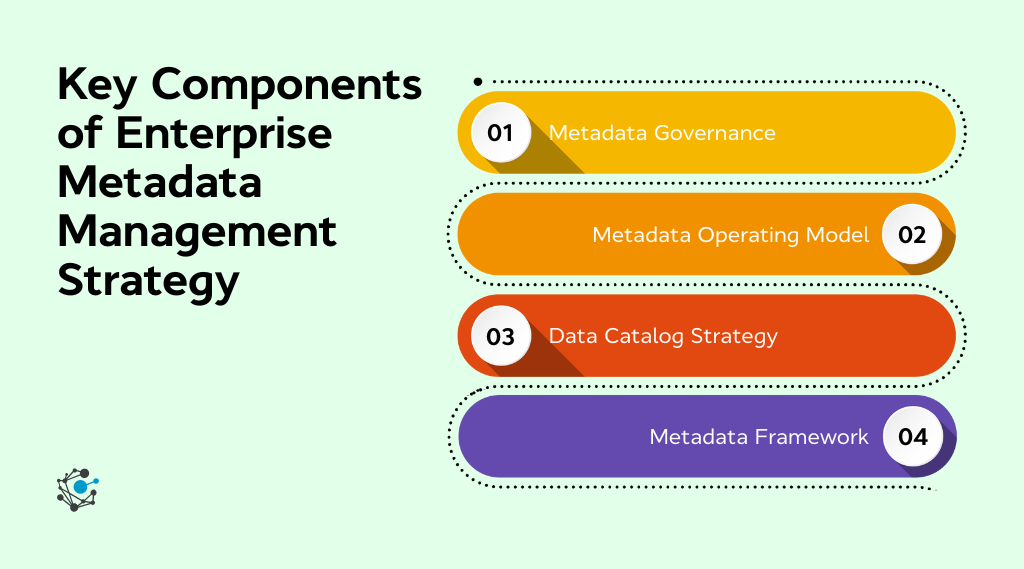
1. Metadata governance
Metadata governance sets the framework for how metadata is created, maintained, and used across the organization. A well-defined governance model ensures metadata stays consistent, accurate, and aligned with business objectives.
-
Establishing data stewardship roles. Data stewards are accountable for metadata quality and governance throughout its lifecycle. In large enterprises, appointing stewards at multiple levels ensures a consistent approach across departments and systems.
For role definitions and RACI examples, see our data stewardship guide.
-
Defining metadata standards and guidelines. Clear standards for how metadata is created, classified, and labeled prevent discrepancies and ensure that metadata can be easily discovered and understood across the organization.
-
Ensuring compliance with regulations. Governance policies enforce how sensitive data is handled across systems. For example, metadata governance can track and manage PII to ensure it stays compliant with GDPR, CCPA, and other data protection requirements.
2. Metadata operating model
The metadata operating model defines the structure for how metadata is managed across the organization, the processes, people, and tools needed to handle metadata throughout its lifecycle. It ensures IT, business, and governance teams stay aligned on how metadata is handled and integrated.
-
Defining workflows for metadata discovery and maintenance. Metadata management needs a structured process for continuous discovery, classification, and maintenance. Automation handles the bulk of this, so AI-powered tools can discover and categorize metadata at scale, while manual review covers refinement and edge cases.
-
Ensuring seamless integration across systems. Data is often siloed across warehouses, BI tools, and data lakes. A robust operating model ensures metadata flows across all of these, giving the organization a single source of truth and reducing the risk of inconsistencies.
-
Aligning data governance and IT teams. IT implements the tools; business stakeholders define the requirements. Regular collaboration between both ensures metadata governance policies are technically sound and operationally relevant.
3. Data catalog strategy
A data catalog serves as the centralized repository for all metadata, enabling users across the organization to discover and access data easily. A well-structured catalog improves data visibility, reduces redundancy, and streamlines workflows.
-
Implementing a user-friendly catalog. The catalog must be intuitive, searchable, filterable, and easy to annotate. Features like keyword search, tagging, and filtering reduce the time users spend hunting for data and improve adoption across both technical and business teams.
-
Integrating with data lakes, warehouses, and BI tools. Metadata doesn't exist in a vacuum. The catalog needs to connect to every system where data lives, providing a unified view of how data moves and is used across the organization.
-
Supporting automated metadata discovery and classification. Automated discovery tools scan systems and capture metadata without manual effort. AI-driven tools can also suggest classifications based on usage patterns, keeping the catalog accurate as data volumes grow.
4. Metadata framework
The metadata framework provides a structured approach to classifying, tagging, and documenting metadata, ensuring consistency and alignment with business goals throughout the metadata lifecycle.
-
Selecting tools that support scalable metadata management. As data volumes grow, the tools must keep pace. OvalEdge, for example, provides automated classification, lineage tracking, and data governance integration that scales with the organization.
-
Defining metadata lifecycle stages. Every piece of metadata moves through discovery, classification, active use, and archiving. Defining these stages explicitly ensures metadata stays accurate and compliant at every point in its journey.
-
Ensuring alignment with data governance and business objectives. The framework must serve the organization's goals. If data privacy is the priority, sensitive data should be tagged and tracked accordingly. If accessibility is the goal, the framework should optimize for searchability and discoverability.
Active metadata: the layer that makes AI usable
Static metadata sits in a catalog and waits to be searched. Active metadata moves. It pushes alerts when a column changes, surfaces lineage in the BI tool a user is already in, certifies data products programmatically, and feeds AI agents the context they need to answer business questions without hallucinating.
Three shifts make active metadata the default model for enterprise teams now:
-
AI agents need grounded context. A coding assistant or analytics agent that can't see schema, lineage, and ownership will guess. Metadata is the grounding layer.
-
Governance has to be runtime. Compliance with GDPR, the EU AI Act, and SOX is not satisfied by a quarterly review. It requires policies enforced at the moment data is queried, copied, or used to train a model.
-
Self-service has to come with control. Democratized analytics without governed metadata is the fastest way to lose audit-ready reporting. Active metadata is how organizations get both.
OvalEdge applies active metadata across the catalog, lineage, and governance layers, every classification, lineage edge, and policy is available to BI tools, AI agents, and stewardship workflows in real time, not on a refresh schedule.
See active metadata in action. OvalEdge's active metadata platform unifies catalog, lineage, governance, and policy enforcement across 100+ connectors, with column-level lineage and AI-agent-ready APIs.

Book a quick demo.
How to build an enterprise metadata management framework
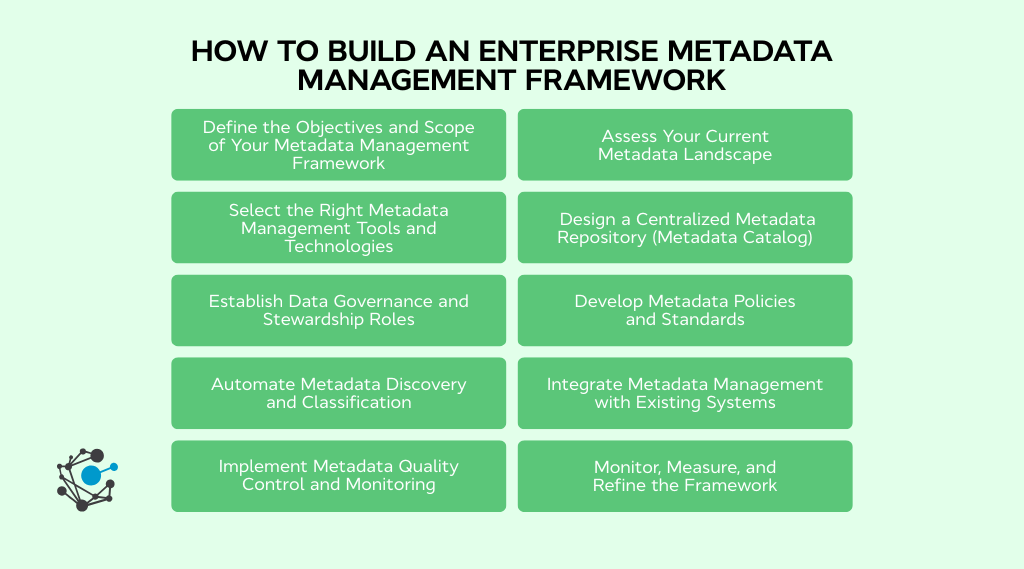
The framework is divided into three phases. Phase 1 sets the strategy. Phase 2 builds the platform. Phase 3 keeps it alive. Most teams skip Phase 3, which is why most metadata programs lose momentum after the first year.
For the underlying metadata framework for governance, see our companion guide.
Phase 1: Strategy (weeks 1–4)
Step 1: Define the objectives and scope of your metadata management framework
Without well-defined objectives, metadata management can become fragmented and ineffective. The objectives could vary depending on your organization's specific needs, improving data discoverability, supporting data analytics, enhancing data quality, or ensuring regulatory compliance.
Defining these objectives will help you determine the scope of your metadata framework.
-
Align the metadata management strategy with business objectives.
-
Define measurable goals, such as improving data accessibility, accuracy, or compliance.
-
Ensure that your framework supports organizational growth and scalability.
Step 2: Assess your current metadata landscape
Conduct a detailed audit to evaluate the current state of metadata within your systems.
-
Are you using standardized practices across departments?
-
Is metadata scattered across different silos, making it difficult to track and manage?
Identifying gaps in metadata quality, coverage, and governance will give you a clear picture of the challenges you need to address.
-
Conduct an in-depth audit of your current metadata systems, tools, and practices.
-
Identify inefficiencies, gaps in governance, and areas where standardization is needed.
-
Understand the data flow across systems to identify integration challenges.
Step 3: Select the right metadata management tools and technologies
Choosing the right metadata management tools is crucial for the success of your framework. The tools you select should align with the goals of your strategy, whether it’s improving data discovery, automating metadata classification, or integrating metadata across systems.
There are various tools available in the market that offer features like automated metadata discovery, data lineage tracking, and integration with business intelligence (BI) tools and data lakes.
|
For instance, OvalEdge provides comprehensive metadata management capabilities that can streamline metadata collection, classification, and enforcement of governance policies. |
When selecting tools, ensure that they can scale with your organization’s needs, integrate seamlessly with existing systems, and offer user-friendly interfaces for both IT teams and business stakeholders. AI-powered tools that automate metadata classification can save significant time and reduce manual errors in the process.
-
Select tools that automate metadata discovery, classification, and lineage tracking.
-
Ensure integration capabilities with existing data systems, such as data lakes, warehouses, and BI platforms.
-
Choose scalable tools that align with both current and future business needs.
Phase 2: Build (weeks 5–16)
Step 4: Design a centralized metadata repository (metadata catalog)
A metadata catalog is a centralized repository where all metadata is stored, organized, and made easily accessible to users across the organization. A well-structured catalog serves as the backbone for metadata management, providing a unified view of all data assets and facilitating quick discovery of relevant information.
Centralized does not mean monolithic. It means one searchable surface backed by federated sources. The catalog stores definitions, lineage, owners, and policies in one place but pulls from where the metadata actually lives. Ensure it supports easy searchability and categorization, and provides metadata details such as data definitions, data relationships, data owners, and data lineage.
Integration with other systems like data lakes, BI tools, and CRM systems is essential to ensure that metadata flows seamlessly across platforms, providing a single source of truth for data assets.
-
Design a centralized metadata repository to store and organize metadata.
-
Ensure the catalog is searchable and supports metadata categorization for easy access.
-
Integrate the catalog with existing data systems to provide a comprehensive view of data assets.
|
For a full architecture overview, see our guide to the enterprise data catalog. |
Step 5: Establish data governance and stewardship roles
Assigning clear data stewardship roles is crucial for ensuring accountability and consistency in metadata management. These roles include data stewards, who are responsible for managing metadata quality.
Data owners, who oversee metadata within specific departments and governance officers, who ensure that metadata practices comply with legal and regulatory standards.
-
Define roles for data stewards, owners, and governance officers to ensure accountability.
-
Establish processes for managing and maintaining metadata quality.
-
Ensure alignment with legal and regulatory compliance standards, such as GDPR and HIPAA.
Step 6: Develop metadata policies and standards
Developing comprehensive metadata policies and standards is essential to ensure that metadata is consistently created, maintained, and used throughout its lifecycle. These policies should define clear guidelines for metadata formats, classification schemes, and data definitions to ensure consistency across systems.
By establishing standard metadata formats and classification systems, organizations can ensure that metadata is structured in a way that makes it easy to search, use, and understand.
Policies should also address metadata lifecycle management, defining how metadata is created, updated, and archived. This ensures that metadata remains accurate and up to date over time.
-
Develop policies that define metadata formats, classification systems, and data definitions.
-
Ensure compliance with industry-specific regulations, such as HIPAA or GDPR.
-
Establish processes for managing metadata throughout its lifecycle, from creation to archiving.
Step 7: Automate metadata discovery and classification
Automation is a key component of an efficient metadata management framework. Automated metadata discovery tools can scan systems, identify metadata, and categorize it according to predefined rules. This not only reduces manual effort but also ensures that metadata is consistently updated and properly classified.
Automation also enhances metadata quality by ensuring that it remains up to date and consistent across the organization.
-
Implement tools that automate metadata discovery and classification.
-
Reduce manual effort and improve the accuracy and consistency of metadata.
-
Use AI-powered tools to continuously classify and update metadata.
Step 8: Integrate metadata management with existing systems
Metadata management should not exist in isolation. It needs to integrate seamlessly with other enterprise systems like data lakes, data warehouses, and business intelligence (BI) platforms. Integration ensures that metadata is synchronized across systems, providing a unified view of data assets.
-
Ensure integration with existing systems, including data lakes, data warehouses, and BI tools.
-
Synchronize metadata across platforms for a comprehensive view of data assets.
-
Enhance decision-making by enabling real-time access to up-to-date metadata.
Phase 3: Operate (ongoing)
Step 9: Implement metadata quality control and monitoring
Establishing processes for metadata quality control and monitoring is essential for maintaining the accuracy and consistency of metadata over time. Regular quality checks and audits ensure that metadata remains up to date and compliant with governance policies.
Automated tools can be used to conduct continuous quality checks, flagging any discrepancies or inconsistencies in metadata.
-
Implement automated tools for continuous metadata quality checks.
-
Regularly audit metadata to ensure accuracy and consistency.
-
Use KPIs to monitor metadata quality and make adjustments as needed.
Step 10: Monitor, measure, and refine the framework
Once the metadata management framework is in place, it’s essential to monitor and measure its effectiveness. Regular performance reviews will help you identify areas for improvement and ensure that the framework continues to meet organizational needs.
Track key metrics such as metadata usage, data discoverability, and compliance rates. Use these insights to refine the framework and update policies as business needs evolve.
-
Regularly review metadata management performance using key metrics.
-
Use insights to refine the framework and adapt to new business requirements.
-
Continuously improve the framework based on feedback and evolving needs.
Challenges of enterprise metadata management
Managing metadata across distributed systems and multiple business units is not straightforward. Here are the five most common obstacles organizations run into, and how to fix them.
1. Managing data silos
Data silos occur when metadata is isolated in separate systems or departments, hindering accessibility and usability across the organization. Different teams use their own specialized tools, so metadata ends up in disconnected databases with inconsistent formatting and no communication between systems.
According to a 2023 Forrester Research on Data Strategy & Insights, these silos hinder efficient analytics and pose significant risks. A marketing department might have a catalog for customer data while finance maintains a separate one for financial records, with no way to integrate or share metadata across platforms.
|
For instance, a marketing department might have a metadata catalog for customer data, while the finance department maintains its own catalog for financial records, both in separate systems with no ability to integrate or share metadata across platforms. This fragmentation not only makes it difficult to gain a comprehensive view of data but also complicates the ability to manage data consistency across the organization. |
The fix: Treat the catalog as the connective layer, not another silo.
-
Centralize without consolidating. A federated metadata catalog pulls from where data actually lives, warehouses, lakes, BI tools, and operational systems, without forcing a migration. One searchable surface, many sources.
-
Standardize definitions first. A shared business glossary eliminates the situation where "revenue" means three different things in three different departments.
-
Make cross-domain discovery the default. When a marketing analyst can search the same catalog as a finance analyst, silos stop being a structural problem and start being a search problem, which is solvable.
2. Integrating metadata with existing systems
Many organizations have invested in legacy systems that were not designed for modern metadata management. These systems often lack support for real-time updates or automated discovery, and data stored in incompatible formats makes consolidation into a single framework difficult.
The fix: Don't rip and replace, just bridge and extend.
-
Prioritize connector coverage. The platform you choose needs native connectors for your legacy systems, not just your cloud stack. A tool with 30 connectors is not an enterprise tool if your most critical systems are the 31st through 40th.
-
Use APIs to bridge the gap. Legacy systems that can't be natively integrated can still surface metadata through API layers, slower, but it avoids the cost and risk of a full migration.
-
Sync on a schedule, not a prayer. Set automated sync intervals so the catalog reflects the actual state of those systems, not what they looked like at implementation time.
3. Ensuring data quality and consistency
Inconsistent or inaccurate metadata leads to poor decision-making and inefficient workflows. Metadata for the same data entity, like customer information, is often structured differently across systems, leading to confusion and errors in interpretation.
|
For example, metadata for the same data entity (such as customer information) may be structured differently in various systems, leading to confusion about its meaning and usage. This makes it difficult for users to understand the context of the data, leading to potential errors in data interpretation and usage. |
According to a 2024 Gartner Research Report on Data Quality Programs, 59% of organizations do not measure data quality at all, highlighting a critical gap in how many businesses approach consistency and quality control.
The fix: Stop measuring data quality after the fact. Enforce it at the entry.
-
Validate at ingestion. Every new metadata entry should pass automated validation before it lands in the catalog. Catching a misclassified field at entry takes seconds; catching it after six months of downstream usage takes weeks.
-
Set quality thresholds and monitor them. Define what good metadata looks like: completeness percentage, freshness window, required fields, and track those metrics like a product dashboard.
-
Run regular metadata audits. Quarterly audits surface classification drift, orphaned assets, and ownership gaps before they compound.
4. Compliance with data privacy and security regulations
Adhering to data privacy and security regulations is one of the most critical aspects of metadata management. Regulations such as the General Data Protection Regulation (GDPR) and the California Consumer Privacy Act (CCPA) impose strict rules on how organizations collect, store, and manage sensitive data.
Failure to comply with these regulations can lead to severe financial penalties, reputational damage, and legal repercussions.
The fix: Treat compliance as a runtime property of metadata, not a quarterly review.
-
Classify automatically. Run sensitive data discovery on every new asset at ingestion. ML-based scanners catch 80%+ of regulated fields without manual tagging.
-
Enforce access. A user querying a column tagged "PII-EU" should hit role-based masking by default, not in a code review three sprints later.
-
Audit by lineage. When auditors ask, "Where does this customer's data go?", a lineage graph answers in 30 seconds. A spreadsheet answers in three weeks. See our full breakdown of data governance and compliance for the regulation-by-regulation mapping.
5. Maintaining metadata documentation across the data lifecycle
As data evolves, metadata documentation must be continuously updated to reflect changes in structure, classification, and usage. Without proper documentation, organizations lose track of critical metadata, leading to errors in data access and analysis.
|
For example, if metadata is not updated when new data sources are added or when data is transformed or deleted, users may struggle to understand the current state of data, leading to errors in data access and analysis. |
The fix: Automate the lifecycle so documentation doesn't depend on someone remembering to update it.
-
Track changes in real time. Every schema change, ownership transfer, or data deletion should trigger an automatic metadata update. If your catalog runs on a monthly export schedule, it is a snapshot, and it is already wrong.
-
Define lifecycle stages explicitly. Creation, active use, deprecation, and archiving are four distinct stages with different governance requirements. Define what metadata is required at each stage and automate the transitions where possible.
-
Flag orphaned and stale assets. Assets with no owner, no recent access, and no downstream dependents are candidates for archiving or deletion. Surfacing them proactively keeps the catalog clean and reduces governance overhead over time.
Enterprise metadata management tools: What to look for
The tools market moved from passive catalogs (capture metadata, store it) to active metadata platforms (capture, connect, push back to where the work happens, and feed AI agents). When evaluating, score each tool on these six criteria:
|
Criterion |
What to look for |
Why it matters |
|
Connectors |
80+ native integrations across warehouses, lakes, BI, ETL, ML, and SaaS |
Coverage gaps create blind spots in lineage and governance |
|
Active metadata |
Two-way sync, push notifications, in-context surfaces in Slack/BI |
Static catalogs get abandoned. Active ones get used |
|
Lineage |
Column-level, cross-system, automatic |
Required for impact analysis and regulatory reporting |
|
Governance |
Policies, classifications, access control, audit trail |
Compliance with GDPR, CCPA, HIPAA, SOX, and the EU AI Act |
|
AI readiness |
MCP server support, agent-accessible APIs, prompt-grounding metadata |
Agentic workflows depend on trustworthy metadata at runtime |
|
Time to value |
Days to first catalog, not months |
Most enterprise rollouts stall in implementation |
The leading platforms in 2026 cluster into three groups:
- Catalog-first platforms: Platforms like OvalEdge that are designed around discovery, governance, and stewardship workflows.
- Active metadata platforms: emphasize observability, automation, and active push.
- Cloud-native suites: tightly integrated with the underlying cloud stack.
| For a side-by-side comparison of the top platforms, see ourmetadata management tools guide. |
Conclusion
Most metadata management programs fail before they get to Step 3 of any framework. They fail because the team tries to boil the ocean, catalog every system, define every term, govern every policy, before showing one usable result.
Pick one outcome. Audit readiness for one regulation. Faster onboarding for one analytics team. AI agent grounding for one product. Use that to justify the platform, prove the model, and earn the budget for the rest. Phase 1 is four weeks. Phase 2 is twelve. Phase 3 is forever.
The teams that get this right will be the ones whose metadata is connected, governed, and active across every system that holds data.
Ready to see what active metadata looks like across your stack?

OvalEdge unifies catalog, lineage, governance, and policy enforcement across 100+ connectors, with the active metadata APIs that make AI agents and analytics actually trustworthy. Book a quick demo.
FAQs
1. What is the difference between enterprise metadata and metadata?
Enterprise metadata spans an entire organization, integrating data from multiple departments and systems under a single governance model. Regular metadata typically describes a single dataset within a specific application, with no organization-wide view or policy layer.
2. What are the different types of enterprise metadata?
The four primary types are technical metadata (schemas, lineage, data types), business metadata (glossary terms, ownership, KPI definitions), operational metadata (job runs, freshness, quality scores), and compliance metadata (sensitivity classifications, retention rules, audit logs). A fifth, social or behavioral metadata is becoming standard in active metadata platforms.
3. How does metadata management impact data security?
Metadata management defines access controls, ownership, and sensitivity classifications for every data asset. This gives organizations the audit trail and enforcement layer needed to meet GDPR, CCPA, and HIPAA requirements without manual oversight at every access point.
4. What is the role of a metadata catalog in enterprise metadata management?
A metadata catalog is the central repository that stores, organizes, and surfaces metadata across the organization. It is the tool that makes the strategy searchable. Without it, governance policies have nowhere to land and data discovery stays manual.
5. Can metadata management help with data integration across systems?
Yes. A centralized catalog maps how data moves across systems, ensuring consistent definitions and quality during the integration process. It also surfaces lineage, so teams can see exactly what depends on what before making changes.
6. What is the difference between centralized and decentralized metadata management?
Centralized metadata management stores all metadata in one unified repository, making governance and consistency easier to enforce. Decentralized management distributes storage across systems or domains, offering more autonomy but requiring significantly more coordination to maintain consistency.
7. What is the difference between metadata management and a data catalog?
A data catalog is a tool. Metadata management is the strategy and operating model around it. A catalog stores and surfaces metadata, and metadata management defines who owns it, how it flows, what policies apply, and how it stays accurate. You can buy a catalog without a strategy. The result is a catalog nobody trusts.
8. How does metadata management support AI and agentic analytics?
AI agents and copilots cannot reason about data they cannot see. Metadata is the grounding layer, like schemas, lineage, ownership, classifications, and business definitions, that lets an agent answer a business question without guessing. Active metadata platforms expose this through APIs and MCP servers so agents can query metadata at runtime.
9. Which compliance regulations does metadata management support?
The most common are GDPR (EU privacy), CCPA (California privacy), HIPAA (US healthcare), SOX (US financial reporting), and BCBS 239 (banking). The EU AI Act adds new requirements for AI training data lineage. Metadata management supports all of these by tagging sensitive fields, tracking lineage for audit trails, and enforcing access and retention policies.
Deep-dive whitepapers on modern data governance and agentic analytics
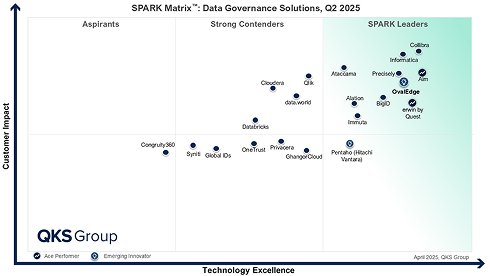
OvalEdge Recognized as a Leader in Data Governance Solutions
.png?width=1081&height=173&name=Forrester%201%20(1).png)
“Reference customers have repeatedly mentioned the great customer service they receive along with the support for their custom requirements, facilitating time to value. OvalEdge fits well with organizations prioritizing business user empowerment within their data governance strategy.”
.png?width=1081&height=241&name=KC%20-%20Logo%201%20(1).png)
“Reference customers have repeatedly mentioned the great customer service they receive along with the support for their custom requirements, facilitating time to value. OvalEdge fits well with organizations prioritizing business user empowerment within their data governance strategy.”
Gartner, Magic Quadrant for Data and Analytics Governance Platforms, January 2025
Gartner does not endorse any vendor, product or service depicted in its research publications, and does not advise technology users to select only those vendors with the highest ratings or other designation. Gartner research publications consist of the opinions of Gartner’s research organization and should not be construed as statements of fact. Gartner disclaims all warranties, expressed or implied, with respect to this research, including any warranties of merchantability or fitness for a particular purpose.
GARTNER and MAGIC QUADRANT are registered trademarks of Gartner, Inc. and/or its affiliates in the U.S. and internationally and are used herein with permission. All rights reserved.